

Green Flash at Sunset: What It Is, Why It Happens, and How to See One
The green flash has reached mythical status due to its rarity and unpredictability. Learn how and when to see this elusive optical phenomenon and what causes it.
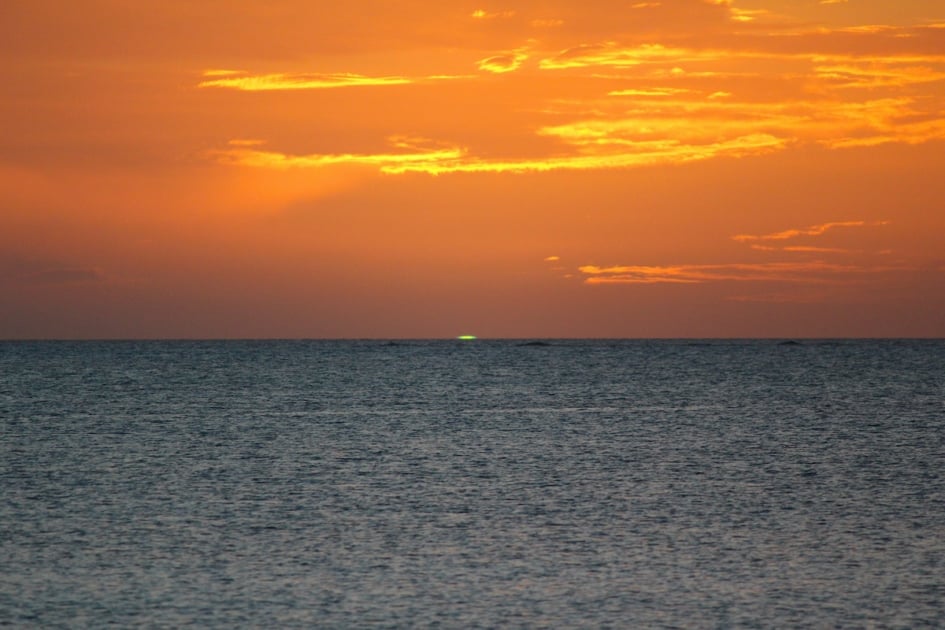
Quick Reference: The Green Flash at Sunset
- What it is: A 1-2 second flash of bright green light at the upper edge of the Sun, the instant before it sets (or, more rarely, the instant after it rises).
- What causes it: Earth’s atmosphere acts as a prism. Shorter wavelengths (green) bend more than longer ones (red), and for a moment green is the only color reaching your eye.
- Is it real? Yes. Documented and photographed for over 150 years. Explained by atmospheric refraction.
- Best conditions: Clear day, no haze, distinct horizon line. Most often seen at sea or from high elevation.
- Four types: Inferior mirage, mock mirage, subduct flash, green ray.
- Spiritual meaning: Folk tradition says seeing a green flash means you will never again misread a heart, and “Pirates of the Caribbean” framed it as a soul returning from the dead.
- Old proverb: “Glimpse you ere the green ray, count the morrow a fine day.”
The green flash at sunset is a real optical event. For one to two seconds, the very last sliver of the setting Sun turns bright green. It looks impossible. It is not. Earth’s atmosphere bends sunlight the same way a prism bends it, and when the Sun is right on the horizon the green wavelength is the last color to reach your eye. Mariners have logged it for centuries. Cameras catch it routinely. You can see one yourself if you know what to watch for.
This guide covers what the green flash at sunset actually is, what causes it, the four types, the folklore and spiritual meaning, the best places to see one, and how to photograph it.

Is the Green Flash Real or Just a Myth?
Yes, the green flash is real. It is a brief optical phenomenon, not a sailor’s tale and not an illusion. For a second or two at sunset (or sunrise) the very top edge of the sun appears emerald green, sometimes followed by a faint upward streak. The cause is straightforward atmospheric refraction: as light from the sun passes through more and more atmosphere near the horizon, the air bends short wavelengths (blue and green) more than long ones (red and orange). The red light disappears below the horizon first, and for a brief moment only the green wavelength remains visible at the very top of the disc.
You have probably never seen one because the conditions are demanding: a sharp, unobstructed horizon (the ocean is best), very clear air, and luck. Photographers chase the green flash specifically; eyewitness accounts from the U.S. National Weather Service and NOAA confirm hundreds of well-documented sightings each year, most along the Pacific coast. So no, it is not a myth – but it is rare enough that the myth-status reputation persists.
Green Flash vs Green Ray vs Zodiacal Light
Three related phenomena often get confused:
- Green flash – the brief green tint at the top of the sun at sunrise or sunset, lasting 1-2 seconds. Caused by atmospheric refraction.
- Green ray – a vertical green streak rising upward from the sun’s last point of contact with the horizon. Rarer than the flash. Same cause, different geometry.
- Zodiacal light – a faint cone of light along the ecliptic visible before sunrise or after sunset, caused by sunlight reflecting off interplanetary dust. Not green at all, and unrelated.
What Is the Green Flash at Sunset?
The green flash at sunset is a brief optical phenomenon in which part of the Sun appears to suddenly change to bright green for about one or two seconds, right as the last sliver dips below the horizon. The flash can also appear at sunrise, the instant before the Sun’s upper edge clears the horizon line, though sunrise sightings are harder because you cannot pre-aim your eye at the right spot.
It is not a halo, not a sundog, and not an afterimage. It is a real wavelength of green light, sorted out of white sunlight by the atmosphere, reaching your eye for the briefest moment.
What Causes the Green Flash at Sunset?
The cause is atmospheric refraction. As the Sun sits on the horizon, its light has to travel through a much thicker slice of atmosphere than when the Sun is overhead. That thick slice acts like a prism. Different wavelengths of light bend by different amounts. Shorter wavelengths (blue, green, violet) bend more than longer ones (red, orange, yellow).
Two things happen in the final second. The longer wavelengths are bent below the horizon first, so red and orange disappear from view. The shortest wavelengths (blue, violet) are scattered by the atmosphere so strongly that they never reach your eye at low angles, which is why low-altitude sunlight looks warm rather than blue. Green sits in the middle. It bends enough to outlast red and orange, and it scatters less than blue and violet, so for a brief moment green is the only color you see at the top edge of the Sun.
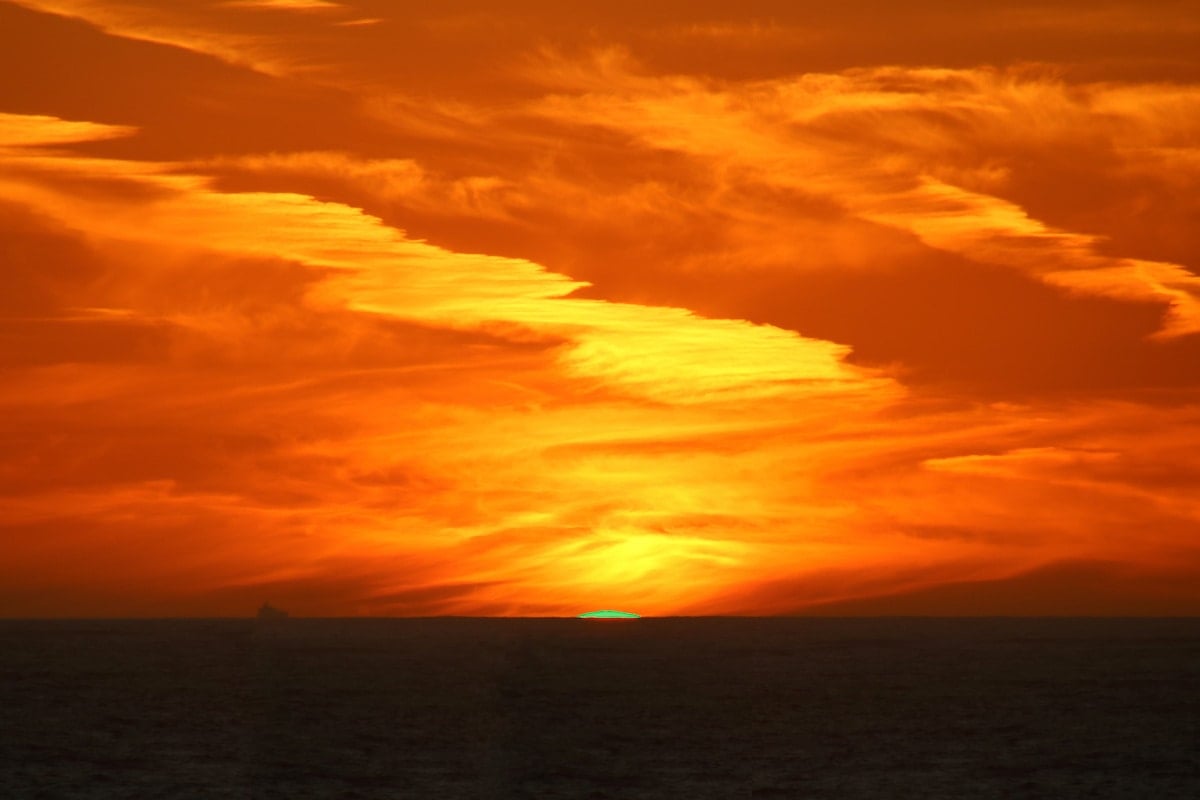
Is the Green Flash at Sunset Real?
Yes. The green flash at sunset is real and well-documented. The earliest scientific accounts date to the 1860s, but mariners and coastal observers logged sightings for hundreds of years before that. The flash has been photographed and filmed thousands of times. It can be reproduced under controlled atmospheric conditions and modeled with standard optics. The reason it gets called a myth is simply that it is rare and brief, not because anyone serious doubts it exists.
The folklore quote about “no artist could obtain on his palette” came from Jules Verne’s 1882 novel Le Rayon-Vert. The real green is in fact obtainable: a saturated, slightly yellowish green close to the color we now call lime or chartreuse. It looks unearthly because of how briefly it appears and the contrast against the surrounding sea or sky.
Types of Green Flashes
Not all green flashes look the same. There are four recognized types, each tied to a specific atmospheric condition.
- Inferior mirage flash. The most common kind. The flash is oval and flat, occurring close to sea level when the water surface is warmer than the air above it.
- Mock mirage flash. The flash appears in thin, pointed strips, lasts one to two seconds, and occurs higher in the sky when the water surface is colder than the air above.
- Subduct flash. Less commonly seen. Occurs when an atmospheric inversion (a warm air layer trapping cool moist air close to the ground) makes the Sun appear to form an hourglass shape. The upper section can glow green for up to 15 seconds, which is by far the longest a green flash can last.
- Green ray. The rarest type. A beam of green light shoots straight up from the green flash immediately after the Sun sets. Caused by a combination of hazy air and one of the other three flash types.
Where Did The Name Come From?
The phrase entered popular language through French writer Jules Verne’s 1882 novel Le Rayon-Vert (The Green Ray), in which the heroine searches for the elusive flash. Verne described the color as “a green which no artist could ever obtain on his palette.” Verne did not invent the phenomenon. He drew on existing sailor lore from the British and French navies, and the book turned a niche maritime observation into a literary symbol of pure, unrepeatable beauty.
Green Flash Lore
Folk tradition says that once you have seen a green flash, you will never again go wrong in matters of the heart. Sailors used to claim a green flash at sunset meant good weather the next day. Fans of the Pirates of the Caribbean movies will recognize the green flash as the on-screen sign of a soul returning from the dead, which is a Hollywood invention but draws on the older association between the flash and supernatural moments.
The flash also shows up in weather lore. An old English proverb claims:
Glimpse you ere the green ray, count the morrow a fine day.
This is a cousin to the more famous “Red Sky At Night” proverb, in which the sunset color forecasts the next day’s weather. A green flash at sunset means a west-facing observer is looking at a clear horizon, which (because the jet stream brings weather from west to east) usually means the next day’s weather will be fair. The same logic shows up across other Farmers’ Almanac weather lore entries.
Spiritual Meaning of the Green Flash at Sunset
The spiritual readings attached to the green flash at sunset are folklore, not doctrine, but they are old and they are widespread. The strongest themes are honesty in love, a glimpse of the divine, and a moment of completion.
- Honesty in love. The most quoted reading, attributed to Verne and to French and Scottish sailor traditions, is that once you have witnessed the green flash you can never again be deceived in love (you read the heart correctly, both your own and others’).
- A soul’s passage. The Pirates of the Caribbean framing draws on an older sailor belief that the green flash marks a soul returning from the deep or crossing a threshold. Many cultures place spiritual weight on the moment of sunset itself, and the flash is the punctuation mark on that moment.
- Good fortune for the next day. The weather-lore reading (“count the morrow a fine day”) slides naturally into a luck-and-blessing reading. To see the green flash is to be present at the right horizon at the right second.
- A moment of clarity. Because the flash requires an unusually clear atmosphere, a quiet observer, and a precise focus on the horizon, some traditions read it as a reward for stillness and attention.
None of these are scientific claims. The physics of the green flash at sunset is simple atmospheric refraction. But the cultural weight is real, and it explains why the flash is treated as a small private blessing by the people who hunt it.
How to See a Green Flash at Sunset
The flash is not impossible to see. It is hard because the conditions have to line up. The prospect of catching one has turned into a quest for many sky watchers. With the right location, the right atmosphere, and a little patience, you can put yourself in the path of the green flash at sunset on a regular basis.
The best conditions for a sunset green flash are:
- A clear day with no haze and no low clouds on the western horizon.
- An unobstructed view of the horizon with a distinct, sharp edge (ocean is ideal; large lakes and high desert work).
- A stable temperature gradient near the surface (steady, not turbulent air).
- Elevation above the surrounding terrain, which lengthens the visible horizon and the duration of the flash.
The green flash is most often seen at sunset rather than sunrise, even though both are possible. At sunrise you have to point your eye at the exact spot on the horizon where the Sun is about to appear, which is much harder to predict than the spot where it will set. Sunset gives you a few minutes of warning.
Never look directly at the Sun until it is almost completely below the horizon. The last few seconds, when only a sliver remains, is the moment to look. Watching the full Sun unfiltered will damage your eyes long before any flash appears.
Capturing a Green Flash on Camera
Cameras detect the green flash more reliably than the human eye, because they can freeze a single frame from a fast burst sequence. To photograph one at sunset, set the camera on a tripod a few minutes before sunset on an evening when the horizon is clear and free of clouds and haze. Shoot in continuous-burst mode so you capture the entire final second of the Sun’s setting edge. Most sightings on review come from the last three to five frames.
A telephoto lens (200mm or longer) helps because the flash is small. So does a stable mounting that lets you frame the Sun without moving the camera at the critical moment. Sunrise green flashes involve more guesswork on exactly where the Sun will appear, so most successful green-flash photographs are taken at sunset.
Where to See the Green Flash in the US (Concrete Locations)
The green flash needs a flat, unobstructed sea-level horizon and clean air. In practice that means the West Coast, Great Lakes shorelines with the right wind, and Florida’s Gulf side. Here are proven US spots, with best-time-of-year windows and why each one works.
Conditions Checklist (Print This Before You Go)
- Horizon: flat and unobstructed all the way to the visible edge. Ocean, big lake, or from an elevated coast.
- Air: clean and dry. Haze, wildfire smoke, and humid hazy days kill it.
- Cloud: not zero, but low. A thin cloud layer far behind the horizon reduces the effect. Small breaks help.
- Timing: watch the very top of the setting sun continuously in the last 15 to 20 seconds before it vanishes. The green flash lasts 1 to 2 seconds.
- Eyes: do not stare at the full disc. Wait until it is a sliver, then focus on the very top edge.
- Camera: use zoom, 400mm+ if you can, and shoot continuous burst. Live-view helps you keep your eyes safe.
Best Spots to See a Green Flash at Sunset
- The Pacific Coast. Long Beach, Santa Monica, La Jolla, and Big Sur all face an open western horizon over open water.
- The Florida Keys. Mallory Square in Key West has nightly sunset gatherings and reliable green-flash sightings on clear evenings.
- Mauna Kea, Hawaii. The summit elevation gives an unmatched horizon view and stable air.
- The Empire State Building observatory. Reported green flashes from the 86th-floor west view at sunset, weather permitting.
- Open ocean cruises. Crews on Pacific or Caribbean routes report multiple flashes per voyage.
- Outer Banks, North Carolina. The wide horizon over the Atlantic at sunset (looking west across the sound) is another reliable East Coast spot.
- Tower viewing platforms in the Rockies and Sierras. High elevation plus a clear westward sightline.
The National Weather Service publishes daily atmospheric clarity and haze indices for coastal stations, which is the best modern indicator that conditions favor a sunset green-flash sighting.
If you enjoy the science of sky optics, you may also enjoy sun halos, sun dogs, and Sun pillars, the aurora borealis viewing forecast, or the four types of green flashes covered above.
Tell us: Have you ever witnessed a green flash at sunset? Share your story in the comments below.

Frequently Asked Questions
What is the green flash at sunset?
A 1-2 second burst of bright green light at the upper edge of the Sun in the instant before it sets (or, more rarely, the instant after it rises). Real, photographable, explained by atmospheric refraction.
What causes the green flash at sunset?
Earth’s atmosphere acts like a prism at low Sun angles. Shorter wavelengths bend more than longer ones, and a thick atmospheric slice scatters blue and violet so strongly that green is the only color left to reach your eye for a brief moment.
Is the green flash at sunset real?
Yes. It is a documented optical phenomenon, repeatedly photographed and explained by physics. Earliest scientific accounts date to the 1860s.
What is the spiritual meaning of the green flash at sunset?
Folk tradition (most often attributed to Jules Verne and to French and Scottish sailor lore) says that once you have seen a green flash, you will never again be deceived in matters of the heart. Other readings frame it as a soul’s passage or a moment of clarity.
How rare is the green flash at sunset?
Rare enough to be a quest, common enough to see several times a year if you live near an open western horizon and watch every clear sunset. Photographers with the right gear and a stable location report multiple captures per month.
Can you see a green flash on land?
Yes, as long as the horizon is far away, the air is clear, and there is no obstruction between you and the setting Sun. High desert, prairie, and elevated viewpoints work. The flash is most commonly reported at sea because the ocean horizon is reliably sharp.
How do I see a green flash at sunset?
Pick a clear, haze-free evening with a sharp horizon. Find an elevated west-facing spot. Do not look at the Sun until only a sliver remains. Watch the upper edge of that final sliver. Try repeatedly across many sunsets.
Can a camera capture the green flash?
Yes. Cameras catch it more reliably than the human eye because burst mode freezes the final second of sunset frame by frame. Use a tripod, a telephoto lens (200mm or longer), and continuous-burst mode.


Natalie LaVolpe
Natalie LaVolpe is a freelance writer and former special education teacher. She is dedicated to healthy living through body and mind. She currently resides on Long Island, New York, with her husband, children, and dog.
- Natalie LaVolpe

- Natalie LaVolpe
- Natalie LaVolpe
- Natalie LaVolpe





I have seen the hazy flash at least 3 times. Always at sunset and just a burst of soft greenish blue flash. I don’t know why, but i thought it was a freak thing that my eyes were doing. Twice in west Texas while hunting in a blind and once in east Texas traveling on a flat highway. I just saw it again in east Texas, so i decided to look it up. It always makes me think of “pixie dust”.
I was on an icebreaker up off of Greenland in the summer of 1980 or 81. I was waiting for the sun to set so I could take an azimuth reading on the upper limb when I saw the flash. I anticipated it would last a couple of seconds, but it sat right there on the horizon. It went from blue, to green, to violet, and it was like a diamond sitting there. It then returned to bright green and began to rise. We were at or above the Arctic Circle, so the sun was close to circumpolar; she dipped below the horizon and began to rise immediately.
I was in Kona Hawai’i for the holidays. I was on a beach at sunset and I saw an amazing green flash shoot up from the sky. It was so lovely. I had to ask my friend what it was and he told me about the green flash and how rare it was. I also saw Kailuea erupt that same visit. I feel very fortunate to see two rare events during my stay.
I just seen the green flash in KS about 2 hours ago! Thought I might be going crazy for a second
Ohhhh! You are lucky! That is on our bucket list!
Last night driving home from the SOFLO Boat show in Miami FL. My daughter and I saw an amazing green blue explosion like light that lit up the whole sky and my niece was also in the car but she didn’t see it … might of been looking at her phone at the moment… but me and my daughter were in amazement …. yep it was like a 1 to 2 second beautiful lighting .. so I searched it up and this is what I found … it was a really amazing beautiful color 💚💙
While living in Key West, FL i tried for 3 months to catch it at sunrise AND sunset. 3 months. its easy to see at sunset, but at sunrise, you cant tell exactly when the sun is about to peek over the horizon. blink and you missed it.. *shrug*
That makes a lot of sense that sunset would be easier! Thank you for sharing!
I capture it all the time.
I saw the green flash about five years ago while on our usual weeks holiday in Bude. We watch the sunset every night the weather allows. It was a brilliant experience, for a split second a marvelous Green diamond flash!
How lucky!!
I am disappointed. I thought it would be more like a small lightening strike. Oh well, better luck next time.
Years ago visiting San Diego and seeing the Pacific Ocean for the first time..watching the sunset which was so beautiful..I saw a lime green flash of color appear for just a second on the horizon, next to the sun. Had I blinked, I would have missed it. The other couple people with me didn’t see it—that’s how brief it was. Seeing it felt really special.
I saw one tonight at San Onofre State Park, Surf Beach!