


Quick Reference: All 12 Birthstones
| Month | Primary Birthstone | Zodiac | Meaning |
|---|---|---|---|
| January | garnet | Capricorn / Aquarius | trust, loyalty, friendship |
| February | amethyst | Aquarius / Pisces | peace, courage, clarity |
| March | aquamarine (bloodstone) | Pisces / Aries | calm seas, safe travel |
| April | diamond | Aries / Taurus | love, strength, endurance |
| May | emerald | Taurus / Gemini | rebirth, wisdom, truth |
| June | pearl (moonstone, alexandrite) | Gemini / Cancer | purity, balance, intuition |
| July | ruby | Cancer / Leo | passion, courage, vitality |
| August | peridot (spinel, sardonyx) | Leo / Virgo | happiness, light, destiny |
| September | sapphire | Virgo / Libra | wisdom, royalty, divine favor |
| October | opal (tourmaline) | Libra / Scorpio | creativity, hope, luck |
| November | topaz (citrine) | Scorpio / Sagittarius | friendship, warmth, abundance |
| December | turquoise (tanzanite, zircon) | Sagittarius / Capricorn | protection, well-being, clarity |
Each month links to its full page with folklore, history, color varieties, and buying tips.
Birthstones tie a single gem to the month a person is born, and the tradition stretches back nearly two thousand years. Some lists are biblical, some Hindu, some Victorian, and the one most American jewelers use today was standardized in 1912 and last updated in 2016. This guide is the Farmers’ Almanac cluster hub for all twelve months. You will find the history, the modern versus traditional split, a quick visual table, and a 50-to-100-word summary for every month with a link to its dedicated page.
What Are Birthstones?
A birthstone is a gem assigned to a calendar month and, by extension, to anyone born in that month. The tradition links three older threads: the twelve stones on the breastplate of the High Priest Aaron in the Book of Exodus, the twelve signs of the zodiac, and the twelve months of the Julian calendar. Early believers thought each stone carried protective or healing power that grew stronger during its assigned month, and a few cultures held that owning all twelve gave the wearer the full set of powers year-round.
The version most Americans recognize today comes from a 1912 meeting of the National Association of Jewelers (now Jewelers of America) in Kansas City. That list, sometimes called the modern birthstone list, has been adjusted three times since: 1952 added alexandrite, citrine, tourmaline, and zircon; 2002 added tanzanite to December; and 2016 added spinel to August. The American Gem Society and the Gemological Institute of America both publish current versions for reference.
The History of Birthstones
The origin most historians point to is the breastplate of Aaron, described in Exodus 28:17 to 28:20. The breastplate was set with twelve stones in four rows of three, one stone for each of the twelve tribes of Israel. Priest and historian Flavius Josephus (37 to about 100 CE) was the first to write that the same twelve stones could also stand for the twelve months and the twelve signs of the zodiac. Saint Jerome echoed this idea in the 5th century CE, suggesting Christians own all twelve and wear the gem of each month in turn.
The shift to wearing one stone all year long, the version we follow now, took shape between the 15th and 18th centuries. Polish and German lapidaries are usually credited with the change. Around the same time, Hindu tradition was developing its own system. The Sanskrit text Ratna Pariksha identified nine gems called Navaratna, tied to celestial bodies and worn together for cosmic balance: ruby, pearl, coral, emerald, yellow sapphire, diamond, blue sapphire, hessonite, and cat’s eye.
In the United States, Tiffany & Co. began publishing a poem matching each month to a stone in 1870, which helped popularize the idea among Victorian gift-givers. The 1912 standardized American list, the 1952 expansion, and the 2002 and 2016 additions are the lineage that brings us to the modern table at the top of this page.
Modern vs Traditional Birthstones
Modern lists reflect what jewelers can reliably stock and what buyers most often ask for. Traditional lists reflect what people wore in the 15th to 19th centuries, when supply was limited and folklore did the heavy lifting. Most months agree. A handful do not.
| Month | Modern (1912/1952/2002/2016) | Traditional |
|---|---|---|
| January | Garnet | Garnet |
| February | Amethyst | Amethyst, hyacinth, pearl |
| March | Aquamarine | Bloodstone, jasper |
| April | Diamond | Diamond, sapphire |
| May | Emerald | Emerald, agate |
| June | Pearl, moonstone, alexandrite | Alexandrite, cat’s eye |
| July | Ruby | Ruby, turquoise, onyx |
| August | Peridot, spinel, sardonyx | Sardonyx, carnelian, alexandrite |
| September | Sapphire | Sapphire, peridot |
| October | Opal, tourmaline | Opal, aquamarine |
| November | Topaz, citrine | Topaz, pearl |
| December | Turquoise, tanzanite, zircon | Turquoise, ruby, lapis lazuli |
The biggest split is March, where bloodstone (traditional) and aquamarine (modern) are very different stones: one dark green and opaque, the other transparent blue. June is the other notable one, with pearl as the modern entry and alexandrite reserved historically for those who could afford the color-change wonder. If you are buying a gift, either list is correct. Pick the stone that suits the wearer.

The 12 Birthstones, Month by Month
Below is a 50-to-100-word summary for every month, with a link to its full guide. Each linked page covers folklore, color varieties, famous examples, care, and zodiac associations in greater depth.
January Birthstone: Garnet
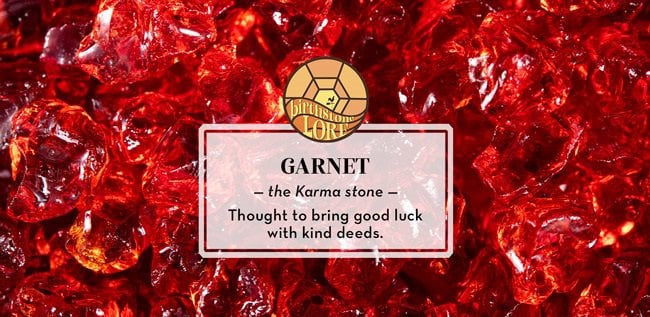
January’s modern birthstone is garnet, a deep red gem the Romans set into signet rings and carried on long trips for safe return. The name comes from granatum, Latin for pomegranate, after the seed-bright color of the most common variety. Garnet is associated with karma, friendship, and steady health. Alternative stones include obsidian and emerald. Read the full January birthstone guide.
February Birthstone: Amethyst
February’s birthstone is amethyst, a purple variety of quartz the Greeks linked to amethystos, meaning not drunken. Wine cups carved from amethyst were thought to keep their owner clear-headed. Today the stone is given for the 6th wedding anniversary and is tied to peace, courage, and inner balance. The traditional alternative is fluorite. Read the full February birthstone guide.
March Birthstone: Aquamarine
March holds two birthstones. Aquamarine, Latin for sea-water, was carried by Greek and Roman sailors as a charm for calm waters and safe passage. Bloodstone, the traditional stone, is a dark green jasper flecked with red and was tied in medieval Europe to courage and the Crucifixion. The two together cover March babies under both modern and old lists. Read the full March birthstone guide.
April Birthstone: Diamond
April’s birthstone is diamond, from the Greek adamas, meaning unconquerable. Mined in India for more than two thousand years, diamonds were thought by ancient Romans to be the tips of fallen stars and the tears of the gods. Today the stone is the standard for engagement rings and the 60th and 75th wedding anniversaries. Alternatives include sapphire, opal, and malachite. Read the full April birthstone guide.
May Birthstone: Emerald
May’s birthstone is emerald, a deep green variety of beryl prized by Cleopatra and mined in Egypt as early as 1500 BCE. The name comes from the Greek smaragdus, simply meaning green. Emerald is the gem of the 20th, 35th, and 55th wedding anniversaries and is tied to rebirth, wisdom, and truth. The traditional alternative is blue lace agate. Read the full May birthstone guide.
June Birthstone: Pearl
June holds three birthstones: pearl, moonstone, and alexandrite. Pearl is the only one grown by a living creature, formed inside a mollusk. Moonstone shimmers with a soft inner glow called adularescence. Alexandrite, the traditional modern entry added in 1952, shifts from green by day to red by lamplight. Pearl is given for the 3rd and 30th wedding anniversaries. Read the full June birthstone guide.
July Birthstone: Ruby
July’s birthstone is ruby, a red variety of corundum and the same mineral family as sapphire. The Sanskrit name is ratnaraj, the king of gems. Burmese rubies were once believed to make warriors invincible. Today ruby is associated with passion, vitality, and the 15th and 40th wedding anniversaries. The traditional alternative is onyx. Read the full July birthstone guide.
August Birthstone: Peridot
August holds three birthstones: peridot, spinel, and sardonyx. Peridot is one of the few gems that forms in the Earth’s mantle and has also been found in meteorites, which is why we call it the space gem. Spinel was added to the list in 2016. Sardonyx, the ancient traditional stone, was worn by Roman soldiers for courage and protection in battle. Read the full August birthstone guide.
September Birthstone: Sapphire
September’s birthstone is sapphire, the blue variety of corundum that medieval kings wore as a guard against envy and harm. Sanskrit and Greek roots both point to the color blue. Sapphires also come in yellow, pink, and white. Princess Diana’s blue sapphire engagement ring is among the most famous. The stone marks the 5th and 45th wedding anniversaries. Read the full September birthstone guide.
October Birthstone: Opal
October holds two birthstones: opal and tourmaline. Opal, from the Sanskrit upala meaning precious stone, was called the queen of gems by the Romans for its shifting rainbow of colors. Tourmaline, added in 1952, comes in more colors than any other gem species. Opal is tied to creativity and hope; tourmaline is tied to safety and clarity of thought. Read the full October birthstone guide.
November Birthstone: Topaz
November holds two birthstones: topaz and citrine. Topaz, often a warm yellow or orange, was tied in the Middle Ages to friendship, strength, and protection from harm. Citrine, a sun-bright quartz added in 1952, gets its name from the Latin citrus. Both stones are tied to warmth, generosity, and the 13th and 17th wedding anniversaries. Read the full November birthstone guide.
December Birthstone: Turquoise
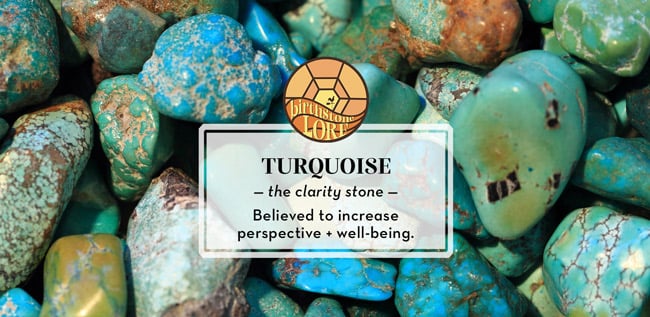
December holds three birthstones: turquoise, tanzanite, and blue zircon. Turquoise has been mined for at least 5,000 years and was sacred to Egyptian and Native American cultures. Tanzanite was discovered in 1967 in the foothills of Mount Kilimanjaro and added to the list in 2002. Blue zircon, often confused with synthetic cubic zirconia, is a natural mineral with brilliant fire. Read the full December birthstone guide.
Choosing a Birthstone as a Gift
A birthstone gift carries more weight than a generic piece of jewelry. The simplest rule is to use the recipient’s birth month, but a few practical notes help:
- Ask which list they prefer. If the modern stone does not suit them, the traditional alternative usually does. March’s bloodstone fits a more rustic taste; aquamarine reads bridal.
- Match the metal. Yellow gold flatters warm stones like ruby, citrine, topaz, and garnet. White gold and platinum flatter cool stones like sapphire, aquamarine, and diamond.
- Think about hardness. Stones used in everyday rings need to sit above Mohs 7. Pearl (2.5 to 4.5), opal (5.5 to 6.5), and turquoise (5 to 6) are softer and do better as earrings or pendants.
- Wedding-anniversary milestones already lean on specific stones (pearl for 30, ruby for 40, sapphire for 45, emerald for 55, diamond for 60 and 75). A birthstone that happens to overlap doubles the meaning.
- Ask for an origin disclosure. The Jewelers of America trade group requires its members to disclose treatments and country of origin on request. A reputable jeweler will share both without prompting.
Birthstone Care Basics
Mohs hardness is a 1-to-10 scale that ranks how easily a mineral can be scratched. Diamond sits at 10, ruby and sapphire at 9, topaz at 8, emerald and aquamarine at 7.5 to 8, garnet and tourmaline at 7 to 7.5, and the softer stones (peridot, opal, turquoise, pearl) sit lower. The lower the number, the more careful you have to be.
- Warm water, mild soap, soft brush works for almost every stone above Mohs 7.
- Skip the ultrasonic cleaner for emerald, opal, pearl, turquoise, and any stone with fillers or fractures. The vibration can split it.
- Store gems separately. A loose diamond will scratch every softer stone it touches.
- Take pearls and opals off before swimming, showering, or applying perfume. Chlorine, salt water, and alcohol pull moisture out of the stone.
- Have prong-set rings inspected once a year. A loose prong is the most common reason a birthstone goes missing.

Birthstone FAQ
Can I wear a different month’s birthstone?
Yes. The month assignment is tradition, not rule. Many people wear the stone they love most, or a parent’s or partner’s birthstone, or all twelve at once. Saint Jerome actually recommended owning the full set and rotating them through the year.
Why does my month have more than one birthstone?
Five months hold more than one modern birthstone: March, June, August, October, November, and December. The extras were added in 1952, 2002, and 2016 to account for newly discovered gems (tanzanite, spinel) or to reflect older traditional stones brought back into the modern list. Pick the one you like; both are correct.
Are birthstones the same as zodiac stones?
No, but they overlap. Birthstones are assigned by calendar month (January through December). Zodiac stones are assigned by sun sign (Aries through Pisces), and the sign boundaries fall in the middle of each month. Someone born March 22 is an Aries with March’s birthstone of aquamarine, but the Aries zodiac stone is bloodstone or diamond.
Do birthstones really have healing powers?
Belief in gem-based healing dates back at least to ancient Egypt and shows up in Hindu, Jewish, Christian, and folk traditions. Modern science treats the effects as cultural and psychological rather than physical. The folklore is real history; the medical claims are not the same as medical evidence.
What is the most valuable birthstone?
Per-carat, top-quality emerald and ruby can outprice diamond at auction, especially in larger sizes with no treatment. The most famous example is the 25.59-carat Sunrise Ruby, which sold at Sotheby’s Geneva for $30.42 million in 2015, the highest price per carat ever paid for a ruby.
What is the softest birthstone, and does it matter?
Pearl is the softest at Mohs 2.5 to 4.5, followed by opal and turquoise. It matters for daily-wear rings (the gem can scratch or chip) but not for earrings, pendants, or occasional-wear pieces. The fix is setting choice, not avoidance.
Who decides the official birthstone list?
In the United States, the list is maintained by Jewelers of America, with input from the American Gem Society and Gemological Institute of America. The current list dates to the 1912 meeting in Kansas City, with updates in 1952, 2002, and 2016.
When did Tiffany first publish a birthstone poem?
1870. Tiffany & Co. printed a one-poem-per-month leaflet pairing each gem with a verse, which helped spread the one-stone-per-month custom across Victorian America before the 1912 standardization.
Join the Discussion
What did you learn about birthstones, history, or folklore today? Which one is yours, and do you prefer your traditional birthstone or an alternative? Tell us in the comments below.

Hmm. Online encyclopedias backup your article, but the dates of Josephus are way off. Under birthstone history, you have this sentence: “Priest, theologian, and historian Flavius Josephus (340-420) discovered the concept of birthstones while studying The Book of Exodus.” He was a first century CE personage. Flavius Josephus (c. 37 – c. 100 CE) was a first-century Romano-Jewish historian and military leader.
Thank you for this information. We appreciate your feedback and sharing this with us.
I love my birthstone in August.
jewelry and gemstone makers are the last people who should ‘tell’ the rest, which stones are for which month. Better to learn about the stones themselves and decide for your-self, which one you ‘feel’ is associated with ‘you’.
04/17/2000
im a little boi named camden i have no tiktok yack shack
Hi im 11
I like reading about gems stones and weather and food
Very interesting! Thanks for everything & all information!???❤️
A lovely story about the birth stones I enjoyed it very much. Thank you for the info of the stones.
The birthstones are not the original. The stone for November is precious topaz, very hard to find, and a good color is marvelous. Expensive also. CITRINE IS USED FOR THOSE REASONS.