

October Birthstones: Opal and Tourmaline (Meaning, Folklore, and Care)
Quick Reference
- October birthstones: opal (traditional) and tourmaline (added 1952).
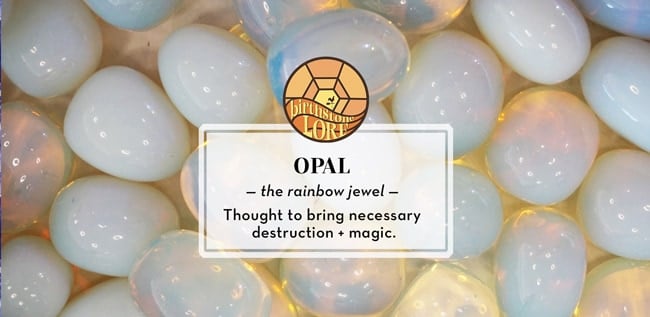
- Opal’s rainbow: silica spheres diffract light into flashes of color (play-of-color).
- Tourmaline’s rainbow: the elbaite mineral grows in nearly every color, sometimes more than one in the same crystal.
- Meanings: opal for hope and innocence, tourmaline for balance.
- Zodiac: Libra (through Oct 22), Scorpio (Oct 23 onward).
- Anniversary: opal is the traditional 14th-anniversary gift.
If your birthday lands in October, you get two birthstones. Opal has been October’s gem for centuries, prized for the way it flashes red, green, and blue all at once. Tourmaline joined the list officially in 1952, a more durable stone available in any color of the rainbow.
What Are the October Birthstones?
October claims two official birthstones: opal and tourmaline. Opal was listed by the National Association of Jewelers in 1912; tourmaline was added formally in 1952. Both are recognized today by the American Gem Society and the Gemological Institute of America (GIA). Opal is silica with up to 21% water locked inside, soft and fragile. Tourmaline is a hard borosilicate crystal that grows in nearly every color in the spectrum.
Opal Stone Facts
How It Is Formed
Scientists still debate how opal forms. Three theories lead the field:
- Standard model: water moves through sandstone, picks up silica, and leaves a silica-rich deposit. Over time, with changes in acidity and evaporation, the deposit hardens into opal.
- Syntectonic Model: silica-rich groundwater is pushed up from below through faults in the Earth’s surface, depositing opal as it rises.
- Microbe Model: credited to Dr. Hans-Jurgen Behr, a German scientist. Behr argues opal forms from a mix of bacteria, enzymes, and soil acids. Microscope work has turned up fossilized microbes inside opal, supporting his theory.
“Lump” (Rather Than Crystal) Formation
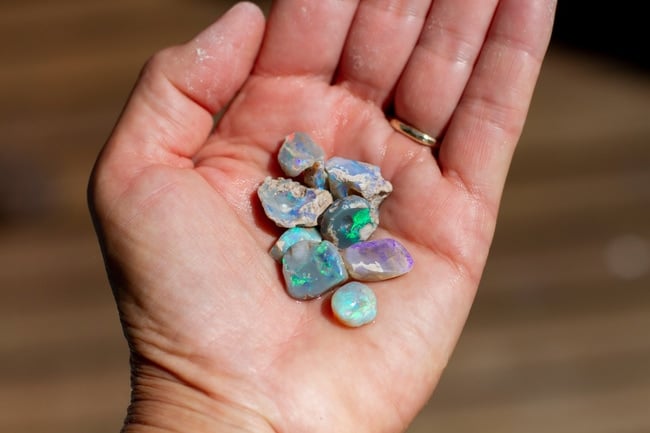
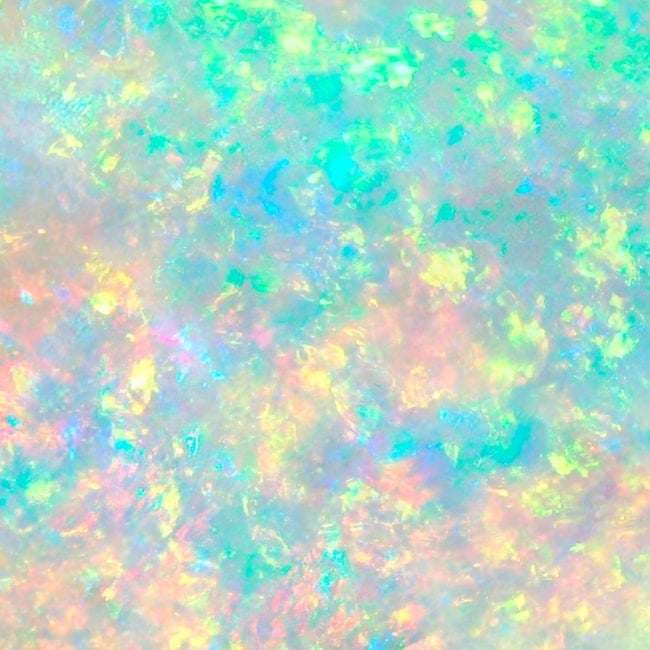
Opal is the odd stone out in the gem world. It holds 3 to 21% water by weight and has no crystalline structure. Instead of a rigid lattice, opal is built from tiny silica spheres packed together in ball or lump formations. Light bends and splits as it passes through, which is why one opal flashes blue and green from one angle and red and orange from another. Gemologists call the effect play-of-color.
Opal: History and Lore
Opal has been admired since Roman times. The naturalist Pliny the Elder called it the “queen of gems,” writing that opal combined the colors of every other precious stone in one jewel. A Roman senator named Nonius carried a famous specimen, “Pliny’s Opal,” that Mark Antony coveted so badly Nonius fled Rome rather than give it up.
For nearly 1,800 years, Europe’s opals came from one source: the Hungarian and Slovakian mines of the old Austro-Hungarian Empire. That changed in 1875, when Australian opal reached the world market. By the late 1880s, prospectors had found black opal at Lightning Ridge in New South Wales, and Queensland soon yielded boulder opal locked inside ironstone.
Tourmaline: History and Lore
Tourmaline has been confused with other gems for most of its history. The name comes from the Sinhalese turmali, a catch-all label Sri Lankan traders used for mixed colored stones. For centuries, green tourmaline sold as emerald, red as ruby, blue as sapphire. Brazilian “emeralds” sent to Portugal in the 1500s turned out to be tourmaline.
Tourmaline was identified as a separate mineral species in 1703, the first mineral classified by chemistry rather than color. It is one of the few gems that is both pyroelectric and piezoelectric: it generates a small static charge when heated or pressed. Dutch jewelers in the 1700s noticed warm tourmalines pulled ash out of their pipes.
The most famous tourmaline collector was Empress Dowager Cixi of China. In the 1880s, she became obsessed with pink tourmaline from newly opened mines in San Diego County, California. Her buyers bought so much that the California industry boomed for two decades. When the Qing dynasty fell in 1912, the market collapsed almost overnight.
Folklore
Rainbows And Footprints
Aboriginal Australian tradition says the Creator came down to earth on a rainbow, and wherever the Creator’s feet touched, the stones underfoot turned into opals. Australia produces about 95% of the world’s opal, so the origin story fits.
Another Australian legend tells of two tribes locked in a long war. Out of weapons, they began hurling stones. One stone flew so high it stuck in the sky, swelled, and burst into every color of the rainbow. In grief, the opal spirit wept down a rainstorm; the sun came out, and the first rainbow appeared. Whenever a rainbow appears, the story says, a tribal law has been broken and the opal spirit is crying again.
Bolts Of Lightning
Arabic legend has it that opals fell from the sky inside bolts of lightning. The story took on extra weight after black opal was discovered at Lightning Ridge in Australia, the very place lightning seemed to point.
Tears Of Zeus
Greek mythology says opals were created from the tears Zeus shed in joy after defeating the Titans. Greeks believed opal granted prophecy and protected against disease.
Necessary Destruction
The Aztecs called fire opal the “Stone of the Bird of Paradise” after Quetzalcoatl, the feathered-serpent god. They believed the stone could bring on the kind of necessary destruction that clears space for new creation.
Good Luck, Abundance, And Magic
In the Middle Ages, people believed opal carried the powers of every gem whose color appeared inside it: green meant emerald, red meant ruby, blue meant sapphire. One opal was the equivalent of wearing many stones at once.
The inner fire of the stone was said to attract abundance, and black opal in particular was thought to help magicians, storing power for release when needed.
Opal Varieties
Not every opal looks alike. The trade recognizes several main types:
- White opal: milky body with pastel play-of-color. Most common precious opal.
- Black opal: dark body, vivid color flash. Most valuable variety, almost all from Lightning Ridge.
- Boulder opal: forms in cracks inside ironstone, cut with the host rock for support. Queensland.
- Crystal opal: transparent or semi-transparent body, strong color flash. Collector favorite.
- Fire opal: orange, red, or yellow body. Mostly Mexican.
- Common opal (“potch”): no play-of-color. Used as backing for doublets and triplets.
Tourmaline Varieties
Tourmaline grows in more colors than any other gem family. Each color has its own trade name:
- Rubellite: pink to red, colored by manganese. The kind Empress Cixi loved.
- Paraiba: electric neon blue-green, colored by copper. First found in Paraiba, Brazil in 1989. Sets per-carat auction records.
- Indicolite: blue, from sky to deep teal.
- Chrome tourmaline: vivid green from chromium and vanadium, mostly East African.
- Watermelon tourmaline: single crystal with pink core and green rim, often cut in slices.
- Schorl: black tourmaline, the most common variety, used in protective jewelry.
Geology and Sources
Australia supplies about 95% of the world’s opal: Coober Pedy (white and crystal), Lightning Ridge (black), and Andamooka (white and matrix). Welo opal from Ethiopia (discovered 2008) reshaped the market almost overnight. Brazil produces crystal opal in Piaui state; Mexico remains the main source of fire opal.
Tourmaline is mined on every continent with gem deposits. Brazil leads, especially Minas Gerais. Afghanistan and Pakistan produce strong pink and green stones, Madagascar supplies indicolite, East Africa contributes chrome tourmaline, and Maine and California have been historic sources since the 1800s.

Famous October Birthstone Pieces
Aurora Australis
Pulled from Lightning Ridge in 1938, the Aurora Australis holds 180 carats, flashes blue, green, and red in a harlequin pattern, and is valued at roughly $1 million in Australian dollars. The name is another term for the Southern Lights, the Southern Hemisphere’s version of the Northern Lights.
Olympic Australis
One of the largest opals ever found. The Olympic Australis weighs 55.3 grams, measures 16 inches long by 7 wide by 4 thick, and is valued at $5 to $10 million.
The Black Prince
Found in 1915 at Lightning Ridge, one of the first black opals ever mined in Australia. Despite weighing only 60 carats, it sold for $134,500 at a Bonham’s auction in 2012.
Andamooka Opal
The 203-carat “Queen’s Opal” was presented to Queen Elizabeth II during her 1954 royal tour of Australia, set into a diamond necklace.
Roebling Opal
The 2,610-carat Roebling Opal sits in the Smithsonian Institution, mined from Nevada’s Virgin Valley field, one of the largest cut black opals on display anywhere.
Record-Setting Paraiba Tourmalines
Paraiba tourmaline holds some of the highest per-carat prices in the colored-stone market. Top stones from the original Brazilian mines have sold for over $50,000 per carat, eclipsing emeralds and rubies of similar size.
Metaphysical Properties
In ancient times, opal was thought to be good for the eyes and used to treat eye ailments. People also believed an opal wrapped in a bay leaf would make the wearer invisible, which earned it the Latin nickname patronus furum, or “patron of thieves.”
Tourmaline picked up a reputation as a balancing stone. Black tourmaline in particular is still used today as protection against negative energy. There is no scientific evidence for either belief, but the traditions remain popular.
Superstitions
Bad Luck
Opal’s “bad luck” reputation is mostly the work of one novel: Sir Walter Scott’s 1829 Anne of Geierstein, in which a heroine’s magical opal loses its color when sprinkled with holy water and Anne is reduced to a pile of gray ash within two hours.
Some trace the superstition further back, to a 14th-century Black Plague story. A hospital patient is said to have worn a brilliantly colored opal that lost all of its color on the day the patient died. Others say the reputation comes from the stone itself: opal is fragile, and many cutters refuse to work on it (if you break it, you buy it).
The most-told opal curse belongs to Spain’s King Alfonso XII (1857-1885). Alfonso gave his new wife an opal ring from a past love; she died months later. The ring passed to his grandmother Queen Christina (dead within months), his sister (dead within days), and his sister-in-law (dead in three months). Alfonso slid it onto his own little finger and was dead within 24 hours. (His actual cause of death was either tuberculosis or dysentery.)
Another superstition says it is bad luck to wear an opal that is not your birthstone, though the same tradition holds that anyone born during the 6 p.m. hour, on any day of the year, may claim opal as a personal birthstone. Modern gemologists treat the bad-luck stories as folklore.
Name Origins
The name “opal” has three possible roots: the Roman opalus (“precious gem”), the Greek opallios (“opal”), and the Sanskrit upala (“jewel”). “Tourmaline” comes from the Sinhalese turmali, used by Sri Lankan traders for any mixed-color stones they could not identify on sight. Once chemistry caught up with the trade in 1703, the name stuck.
Alternative October Birthstones
Pink Tourmaline
In 1912, the National Association of Jewelers added pink tourmaline alongside opal. It is treated as a heart-centered stone for friendship, compassion, and balance. The Egyptians had their own story: tourmaline came in so many colors because it traveled down a rainbow from the sun to earth, picking up every shade.
Rose Quartz
A second alternative comes from the zodiac side. Rose quartz is tied to Scorpio and described as a powerful stone for love, said to help with loving others and forgiving yourself. Most rose quartz on the market has been dyed, so a true natural piece is worth shopping carefully for.
October Birthstone Folklore and Healing Beliefs
Across cultures, October’s stones carry a wide spread of associations:
- Opal: hope, innocence, creativity, intuition.
- Tourmaline: balance, grounding, protection.
- Black tourmaline: shielding against unwanted energy.
- Pink tourmaline: compassion and self-love.
- Watermelon tourmaline: emotional harmony.
These are folklore traditions, not medical claims. Treat them as stories, not prescriptions.
Opal + Tourmaline and Zodiac
October splits between two zodiac signs.
- Libra (September 23 to October 22): opal is the classic pairing, said to support balance and emotional harmony.
- Scorpio (October 23 to October 31): tourmaline is the more common match, especially rubellite and black tourmaline, both linked to passion and protection.
How to Care for Opal and Tourmaline
Opal is one of the most fragile gems sold at retail (5.5 to 6.5 on the Mohs scale), and its 3 to 21% water content makes it sensitive to dryness and temperature change. If an opal dries out, fine crackles called crazing form across the surface and never repair.
- Clean with warm soapy water and a soft cloth. Nothing else.
- Never use ultrasonic or steam cleaners.
- Store opals separately from harder gems.
- Keep opal away from prolonged dry heat.
- Doublets and triplets should never be soaked.
Tourmaline is easier. It rates 7 to 7.5 on the Mohs scale and tolerates normal jewelry wear. Warm soapy water cleans it well. Skip ultrasonic cleaners if your stone has visible inclusions.
Choosing an October Birthstone
If you cannot decide, these guidelines help.
- Everyday wear: tourmaline (harder, safer in rings).
- Statement pieces: opal, safer in pendants and earrings than rings.
- Color: tourmaline for solid colors, opal for shifting rainbows.
- Gift: Libras lean opal, Scorpios lean tourmaline’s deeper shades.
- Collector value: black opal from Lightning Ridge, Paraiba tourmaline from Brazil.
October Anniversary Significance
Opal is the traditional gift for a 14th wedding anniversary, sitting alongside ivory in the calendar. Tourmaline doubles as the modern eighth-anniversary stone. Either works for a milestone if your partner was born in October, so the gift does two jobs at once.
A Practical Close
October-born readers get a rare gift: two recognized birthstones in very different styles. One is dreamy, fragile, and full of folklore; the other is hard, vivid, and literally electric. Buy one for yourself or pass an heirloom to the next generation. You have options the other eleven months simply do not.

Frequently Asked Questions
What is the October birthstone?
October has two: opal and tourmaline. Opal has been the traditional choice since 1912; tourmaline was added in 1952. Both are recognized by the American Gem Society and the GIA.
Is opal really bad luck?
No. The reputation traces to Sir Walter Scott’s 1829 novel Anne of Geierstein, which crashed European opal prices by about 50%. Modern gemologists openly debunk it.
What is the difference between opal and tourmaline?
Opal is hydrated silica with up to 21% water, fragile, and shows rainbow play-of-color. Tourmaline is a hard borosilicate crystal in nearly every color, more durable for everyday wear.
Why does opal show so many colors?
Opal is built from tiny silica spheres. Light diffracts off them and breaks into separate colors. Gemologists call the effect play-of-color.
Where do October’s birthstones come from?
Australia produces roughly 95% of opal (Lightning Ridge, Coober Pedy, Andamooka). Ethiopia and Mexico also supply opal. Tourmaline comes mainly from Brazil, plus Afghanistan, Pakistan, Madagascar, East Africa, Maine, and California.
How do I care for an opal ring?
Use warm soapy water and a soft cloth. Never use ultrasonic or steam cleaners. Store opal separately and keep it away from dry heat to prevent crazing.
Which birthstone matches my October zodiac?
Libra (October 1-22) traditionally pairs with opal. Scorpio (October 23-31) often pairs with tourmaline, especially rubellite or black tourmaline.
Is opal a good anniversary gift?
Yes. Opal is the traditional 14th-anniversary stone; tourmaline is the modern eighth-anniversary stone.
Join The Discussion
Were you born in October? Do you wear opal, tourmaline, or an alternative like pink tourmaline or rose quartz? Do you put any stock in the old opal superstitions, or treat them as good stories? Which fact or piece of folklore caught your attention most? Tell us in the comments below. We’re looking forward to hearing from you.
Related Reading
- Birthstones By Month, Facts And Folklore
- September Birthstone
- November Birthstone
- October Birth Month Symbols and Fun Facts


Tamra Albright-Johnson
Tamra Albright-Johnson specializes in the unique histories and folklore around rare stones. She owns and operates a custom jewelry shop with her daughter, Kennie, in Iowa.
- Tamra Albright-Johnson

- Tamra Albright-Johnson
- Tamra Albright-Johnson
- Tamra Albright-Johnson

Opals – unlucky?
I wondered about this so I am glad to hear the story behind the myth. I was not born in October but my son was so I wear an Opal. Quite a few years ago I bought myself a pretty ring and the stone fell out within a matter of days so I returned the ring (they offered to fix it but I decided I didn’t want it and thought about that bad luck thing). I love opals!
Opals are gorgeous – and “hopefully” they truly aren’t unlucky – but we’ve heard enough stories like yours to really wonder!
“For some opals are associated with bad luck? But how? Some say it’s from a story written in 1829 called “Anne of Geierstein” by Sir Walter Scott. This story was about a woman named Anne who wore a magical opal able to change colors based on her mood.” So the opal was the first Mood Stone?
Thank you for adding this information. Anne of Geierstein is credited as being the source of the “unlucky” rumors – especially for people who wear Opals when it isn’t their birthstone. However, for many it considered a lucky stone as it can flash all of the colors. We are happy you are a part of our community!
How can you tell if the Opal is genuine?
Thanks
We always recommend taking them to a qualified jeweler that has experience with gemstone identification. Opals are a tricky one to determine by yourself as synthetics are very well done. If you have one, we’d love to see it!
I have many opal jewelry items. I also have to succomb to rose zircon/ quartz because opals are too soft for some pieces. Love my October birthstone!!
Hi Wendy, Thanks for sharing. Glad to hear you love October’s alternative birthstones too! ?
I have opal ring
Hi Mary! Great, we would love to see a picture of it. Post one here!