Quick Reference: Rosh Hashanah 2026
- Begins: Sundown, Friday, September 11, 2026
- Ends: Nightfall, Sunday, September 13, 2026
- Hebrew calendar: 1 and 2 Tishrei, year 5787
- Rule: The first day of Tishrei on the Hebrew lunar calendar
- Greeting: Shanah Tovah (“a good year”)
- Followed by: The Ten Days of Awe, ending with Yom Kippur (Sundown Sunday, September 20 to nightfall Monday, September 21, 2026)
Rosh Hashanah 2026 begins at sundown on Friday, September 11, and ends at nightfall on Sunday, September 13, 2026. The two-day holiday opens the Jewish year 5787 and is observed on the first and second days of Tishrei, the seventh month of the religious calendar and the first of the civil one. It is the head of the Jewish year, a time for family meals, synagogue worship, the sound of the shofar, and quiet reflection on the year past and the year ahead.
When Is Rosh Hashanah 2026?

Rosh Hashanah 2026 begins at sundown on Friday, September 11, and runs through nightfall on Sunday, September 13. Jewish holy days begin at sundown the evening before the date on the Gregorian calendar, because the Hebrew day starts in the evening. The first festive meal is the Friday-evening dinner; the two full days of observance are Saturday, September 12 and Sunday, September 13.
The Hebrew name Rosh Hashanah translates literally to “head of the year.” It marks the start of the year 5787 on the Hebrew calendar, a count traditionally taken from the creation of the world, known as Anno Mundi. The two days are observed together as one long holy day in most communities, both in Israel and the Diaspora.
Rosh Hashanah Dates for the Next Five Years
| Year | Begins (sundown) | Ends (nightfall) | Hebrew Year |
|---|---|---|---|
| 2026 | Friday, September 11 | Sunday, September 13 | 5787 |
| 2027 | Friday, October 1 | Sunday, October 3 | 5788 |
| 2028 | Wednesday, September 20 | Friday, September 22 | 5789 |
| 2029 | Saturday, September 8 | Monday, September 10 | 5790 |
| 2030 | Friday, September 27 | Sunday, September 29 | 5791 |
The Gregorian date drifts because the Hebrew calendar is lunar, with periodic leap months added to keep the holidays in step with the seasons. Rosh Hashanah always falls in September or early October, never earlier than September 5 and never later than October 5. Our full Moon dates and times page tracks the lunar cycle the Hebrew calendar is built on.
What Is Rosh Hashanah?
Rosh Hashanah is the Jewish New Year. The name is Hebrew for “head of the year,” and the holiday opens the High Holy Days, the most solemn stretch of the Jewish calendar. It is a religious and festive time when family and friends gather for meals and worship, draw closer to God, look forward to a new year with anticipation, and reflect on the year past to grow in the year ahead.
The two-day celebration is observed on the first and second days of the Hebrew month of Tishrei, the first month of the civil calendar and the seventh of the religious one. In 2026 it opens the year 5787 by the traditional count from creation, known by the Latin phrase Anno Mundi, “in the year of the world.” The holiday is also called Yom Teruah, the day of sounding the horn, and Yom HaZikaron, the day of remembrance.
The History of Rosh Hashanah
Yom Teruah is the biblical name for this holy day. Teruah means a massive shout by a crowd or the blowing of a horn. The observance traces back to the Torah. In the book of Numbers, the children of Israel were commanded by the Lord to keep the day:
And in the seventh month, on the first day of the month, ye shall have an holy convocation; ye shall do no servile work: it is a day of blowing the trumpets unto you.
Numbers 29:1
A parallel commandment appears in Leviticus 23:23 to 25, where the seventh month is set aside as a sabbath of solemn rest, “a memorial proclaimed with the blast of trumpets, a holy convocation.” Rabbinic tradition later named the first day of Tishrei as the new year and developed the two-day observance kept in most communities, both in Israel and the Diaspora. The day is one of four “new years” named in the Mishnah, alongside the new years for kings, for trees, and for tithing of animals.
How the Date Is Set
Rosh Hashanah is always the first day of Tishrei on the Hebrew calendar. The Hebrew calendar is lunisolar: months follow the cycle of the Moon, and a leap month is added in seven years out of every nineteen so the holidays stay anchored to their seasons. Tishrei opens in early autumn, after the harvest, which is why the Gregorian date drifts from year to year but never wanders far from September.
Two ancient rules keep Rosh Hashanah from falling on certain days of the week. The holiday cannot begin on a Sunday, Wednesday, or Friday, because the calendar is arranged to keep Yom Kippur from landing next to a Sabbath and to keep the seventh day of Sukkot from falling on a Saturday. The result is that Rosh Hashanah in 2026 begins on a Friday at sundown, and the two days of the holiday run through Saturday and Sunday.
How Rosh Hashanah Is Observed
Rosh Hashanah is observed with a careful blend of solemn worship and festive meals at home. The shape of the two days has been the same for generations: candle-lighting at the start of each evening, synagogue services centered on the shofar, a long table set with symbolic foods, and a walk to a body of water for the Tashlich ceremony.
Candle-Lighting
It is customary for the women or girls of the household to light candles in the home to usher in the holiday, and again on each evening throughout Rosh Hashanah. Blessings are recited as the candles are lit. Chabad publishes the full candle-lighting procedure and blessings if you would like the wording.
Blessings & Prayers
Along with the candle blessings each evening, other blessings called Kiddush, meaning sanctification, are recited before the meal. A blessing is spoken over the wine, and another over the bread. A special blessing called Shehecheyanu, which thanks God for bringing the household to this season, is said over a new fruit on the second night.
Festive Meals with Symbolic Foods

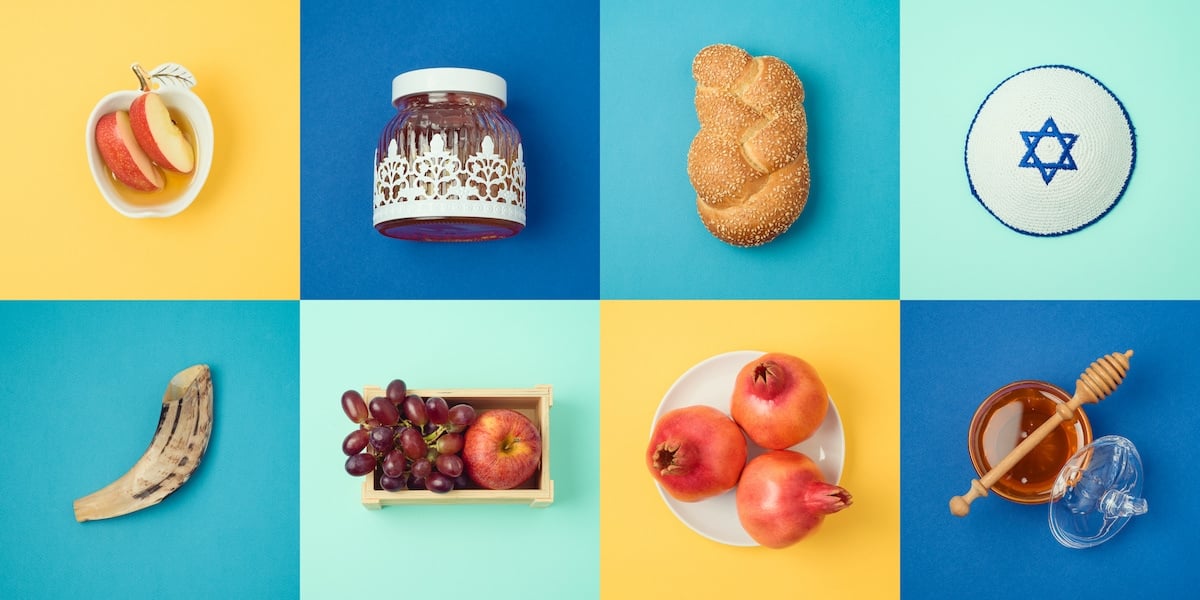
Challah bread is always fashioned into a round loaf for Rosh Hashanah and served with honey. The circle of the bread symbolizes the seasons and the cycle of life, and the honey carries the wish for a sweet new year.
Sliced apples dipped in honey is another Rosh Hashanah tradition. The honey carries the desire for a sweet, enjoyable, and bountiful year. No bitter, sour, or tart foods like horseradish or vinegar appear at this holiday meal.
Pomegranate is another customary food on the Rosh Hashanah table. The vast number of seeds in the fruit represents the desire for a productive and abundant life, and tradition holds that a pomegranate contains 613 seeds, one for each of the commandments in the Torah.

Attend Synagogue Services. Gathering together in a synagogue for prayer is an important part of Rosh Hashanah. Special prayers for the holy service and readings from the Torah are taken from the Machzor prayer book, which is reserved for the High Holy Days. Some synagogues live-stream their services for those unable to attend in person.
Listen to a Shofar. The shofar is a trumpet typically made from a hollowed-out ram’s horn. In ancient biblical times, the shofar was blown during temple worship and in battle, such as at the battle of Jericho in Joshua chapter 6. The sounding of the shofar today remains a key element of the Rosh Hashanah synagogue service. A traditional service includes 100 shofar blasts across the day, in four named patterns: tekiah, a long unbroken blast; shevarim, three medium broken notes; teruah, nine short staccato notes; and tekiah gedolah, a single long sustained blast. For the hearer, the sound is a demonstration of obedience to God’s commandment. According to Rabbi Saadia Gaon, the sound of the shofar stirs excitement, reminds the listener that God is King of the world, and awakens slumbering souls that have grown complacent.

Casting Bread Crumbs on Water. This custom is known as the Tashlich ceremony. The word means “you shall cast,” and the practice involves going to a natural, outdoor water source, a river, creek, lake, pond, or ocean, and tossing bread crumbs onto the water. The act symbolizes casting away the wrongs of the past year. A prayer for the ceremony is found in the Machzor prayer book. Tashlich is traditionally performed on the afternoon of the first day, or on the second day if the first day falls on a Sabbath.
Self-Reflection. Rosh Hashanah encourages self-examination of the past year, a careful look at where you have “missed the mark.” The work is to weigh the personal aspects of your life, the negative and the positive, and to decide what to do differently in the year ahead, how to improve, and how to “hit the mark” in the new year.
The Ten Days of Awe
The ten days between Rosh Hashanah and Yom Kippur are significant days known as the Ten Days of Awe, or the Ten Days of Repentance. In Hebrew the period is called Aseret Yemei Teshuvah, the ten days of returning. In 2026 this stretch runs from the start of Rosh Hashanah on Friday, September 11, through the close of Yom Kippur on Monday, September 21.
During this time, deeper introspection takes place. Other positive ways to use the period for spiritual enrichment are to pray, perform charitable deeds, practice acts of loving kindness, seek forgiveness, and pursue reconciliation with others. The Hebrew word for repentance, teshuvah, literally means “return.” Tradition holds that one’s actions between Rosh Hashanah and Yom Kippur can turn God’s judgments toward us into blessings. The common greeting through these days is, “May you be inscribed and sealed in the Book of Life for a good year.”
Traditional Rosh Hashanah Foods and Greetings
The Rosh Hashanah table is full of food chosen for what it stands for as much as for how it tastes. Each dish carries a wish for the year ahead. A traditional menu often includes:
- Round challah with honey: the round loaf for the cycle of the year, the honey for sweetness.
- Apples dipped in honey: the wish for a sweet new year, eaten with the blessing for a good and sweet year.
- Pomegranate: a fruit of many seeds, eaten on the second night as a “new fruit” for the Shehecheyanu blessing.
- Honey cake: the traditional dessert, prized for its keeping quality across the holiday.
- Tzimmes: a slow-cooked dish of carrots, dried fruit, and honey; the Yiddish word for carrots, mehren, also means “to increase.”
- Fish head: served in some homes to symbolize being the “head, not the tail” in the year ahead.
- Brisket or chicken: the central meat course, often braised with onions and honey.
- Jewish apple cake: an Almanac favorite for the apple-and-honey season. See our recipe for a traditional Jewish apple cake.
The traditional greeting is Shanah Tovah, which means “a good year,” or the fuller L’Shanah Tovah Tikatevu, “may you be inscribed for a good year.” Learning to say the greeting is a small kindness on the first day:
Plan Your Rosh Hashanah 2026
Mark sundown on Friday, September 11, 2026 on the calendar. The cooking, the candles, the synagogue seats, and the walk to the water for Tashlich are all the work of the days right before the holiday. A few small habits make the two days easier:
- Order or reserve round challah from your bakery a week ahead. They sell out by Wednesday in most cities.
- Pick up the apples, honey, and a fresh pomegranate together so you have everything ready for the first night.
- Confirm synagogue ticket arrangements early. High Holy Day seating is by ticket in many congregations.
- Scout a quiet stretch of natural water nearby for the Tashlich ceremony on the afternoon of the first day.
- Reach out to people you have not spoken with for a while. Asking forgiveness is part of the season.

Frequently Asked Questions
When is Rosh Hashanah 2026?
Rosh Hashanah 2026 begins at sundown on Friday, September 11, and ends at nightfall on Sunday, September 13. The two days mark the start of the Hebrew year 5787, observed on the first and second days of the month of Tishrei.
What does Rosh Hashanah mean?
Rosh Hashanah is Hebrew for “head of the year.” It marks the Jewish New Year and the start of the High Holy Days, the ten days of repentance that close with Yom Kippur. In the Torah the day is also called Yom Teruah, the day of sounding the horn.
Why does the date change each year?
The Hebrew calendar is lunisolar. Months follow the Moon, and a leap month is added in seven years out of every nineteen to keep the holidays anchored to their seasons. The first of Tishrei always falls in September or early October on the Gregorian calendar, but the exact date drifts.
What year is it on the Hebrew calendar in 2026?
Rosh Hashanah 2026 opens the Hebrew year 5787. The count traces back to the traditional date of the creation of the world, known in Latin as Anno Mundi, “in the year of the world.”
How many shofar blasts are there?
A traditional Rosh Hashanah service includes 100 shofar blasts, sounded in four named patterns: tekiah (long), shevarim (three medium broken notes), teruah (nine short staccato notes), and tekiah gedolah (one long sustained blast). The patterns are repeated through the service.
What is the proper greeting for Rosh Hashanah?
The traditional greeting is Shanah Tovah, “a good year,” or the fuller L’Shanah Tovah Tikatevu, “may you be inscribed for a good year.” After Rosh Hashanah and through the Ten Days of Awe, many people add the wish, “May you be inscribed and sealed in the Book of Life.”
What are the Ten Days of Awe?
The Ten Days of Awe, in Hebrew Aseret Yemei Teshuvah, are the ten days that begin with Rosh Hashanah and end with Yom Kippur. They are devoted to teshuvah, the practice of return: prayer, charitable deeds, acts of loving kindness, and asking forgiveness from people you have wronged. In 2026 the period runs from sundown September 11 through nightfall September 21.
When is Rosh Hashanah 2027?
Rosh Hashanah 2027 begins at sundown on Friday, October 1, and ends at nightfall on Sunday, October 3. The two days open the Hebrew year 5788.
Join The Discussion!
What are some special ways that your family will celebrate Rosh Hashanah 2026? A particular round challah you bake every year, the apples-and-honey moment at the start of the meal, a favorite Tashlich spot, the shofar service at your synagogue, a recipe from a grandparent? Let us know in the comments below.
Related
How To Make A Traditional Jewish Apple Cake

Deborah Tukua
Deborah Tukua is a natural living, healthy lifestyle writer and author of 7 non-fiction books, including Pearls of Garden Wisdom: Time-Saving Tips and Techniques from a Country Home, Pearls of Country Wisdom: Hints from a Small Town on Keeping Garden and Home, and Naturally Sweet Blender Treats. Tukua has been a writer for the Farmers' Almanac since 2004.
- Deborah Tukua

- Deborah Tukua
- Deborah Tukua
- Deborah Tukua