

What’s a Haboob?
Find out what a haboob is and what to do if you're ever caught in one.
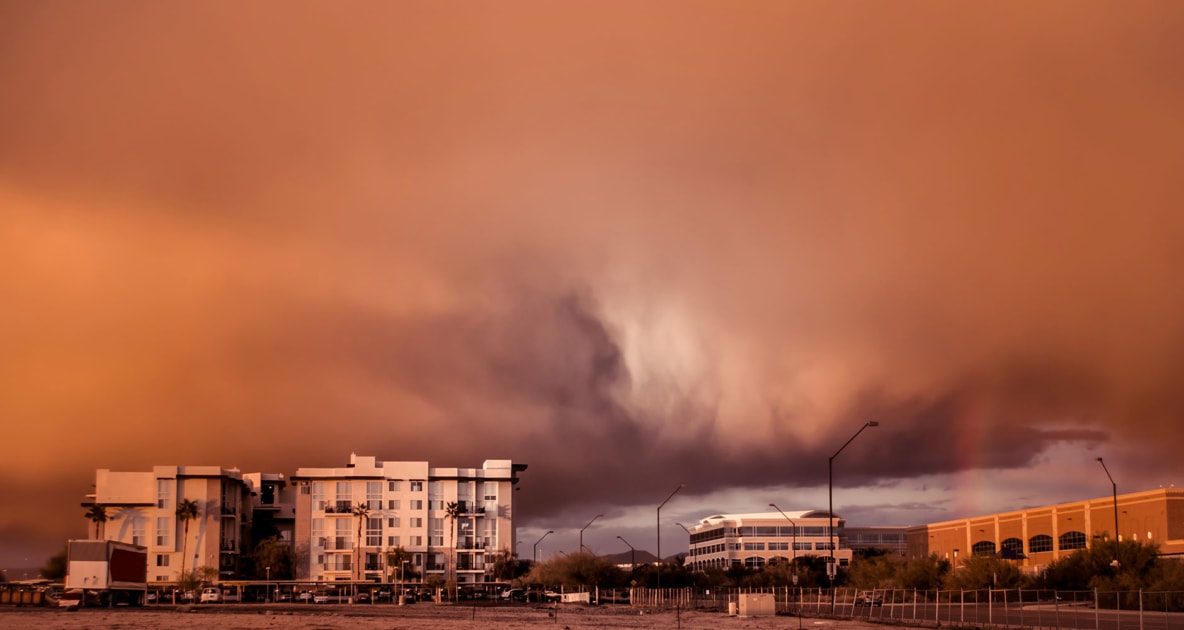
Quick Reference
- What: A wall of dust several miles high, kicked up by a thunderstorm’s outflow over arid ground.
- Name origin: Arabic for “blasting.”
- Where: Arabian Peninsula, North African Sahara, Australian outback, and the desert Southwest U.S. (Phoenix, Tucson, Las Vegas).
- Wind speed: Over 60 mph at the leading edge.
- If you are driving in one: Pull aside, stop, and wait. Visibility can drop to zero.
Think about dust. It sounds benign, a nuisance for meticulous housekeepers, perhaps, but essentially harmless.
Now think about a towering cloud of dust several miles high enveloping the world around you. The dust swallows up buildings, cars, people, everything for miles in every direction. It is impossible to see a thing and hard to breathe. Dust gets in your eyes, your nose, your mouth, into the grill of your car. It sticks to your skin and leaves a gritty film on every surface.

What Is A Haboob?
This is a haboob, a large, severe dust storm that happens in arid regions. The name comes from the Arabic word for “blasting.” Haboobs are fairly common on the Arabian Peninsula, which is mostly desert.
Even though this type of storm takes its name from a region half a world away, North America is no stranger to haboobs. Dangerous dust storms are a part of life in many parts of the United States, especially in the dry, dusty Southwest. Even areas that are not usually prone to dust storms can get them during periods of intense drought. This happened often during the “Dust Bowl” era of the 1930s, when dust storms became so frequent and intense that homes and farms became partially buried under piles of dirt.
How a Haboob Forms
Haboobs are caused when a high-pressure storm system moves through an area. Intense storms pull air up from beneath them and push air out in either direction. When this happens in a wet region, it is just like any other wind, albeit an intense one. When it happens in an arid region, though, the wind stirs up countless tiny dust particles, agitating them into a moving wall of dirt. Winds in a haboob can travel faster than 60 miles per hour.
- Step 1. A thunderstorm cell builds over or near the desert.
- Step 2. Cold downdrafts hit the ground and spread outward as a gust front.
- Step 3. The gust front lifts loose dust and sand off the dry surface.
- Step 4. The wall of dust rises 1 to 5 miles high and races outward at 30 to 60+ mph.
- Step 5. The storm passes and the dust settles, sometimes inches deep on cars, decks, and pools.
Haboobs in the Desert Southwest
| Date | Location | Notable |
|---|---|---|
| July 5, 2011 | Phoenix, Arizona | “The Phoenix Haboob,” 50 miles wide, 5,000 feet tall, 60 mph gusts |
| August 18, 2011 | Phoenix, Arizona | Followed-up dust wall, multiple flight diversions at PHX |
| May 1, 2014 | Lubbock, Texas | First major haboob in West Texas in decades |
| April 13, 1935 | Oklahoma Panhandle | “Black Sunday,” the most famous Dust Bowl haboob |
Though haboobs can be sudden and unpredictable, the National Weather Service does issue haboob warnings in areas where they are common. Visibility inside of a haboob can be zero, making them especially dangerous for unsuspecting drivers.
How to Stay Safe
If you ever find yourself inside a haboob while driving, the best thing to do is to pull over and wait it out. If you are outside during a haboob, try to find shelter. Getting dust in your eyes and lungs can be dangerous.
- Pull aside, stay alive. Pull off the road, set the parking brake, turn off all lights, and keep your foot off the brake pedal. The Arizona DOT campaign is named for the rule.
- Close vents and windows. Switch your car’s ventilation to recirculate.
- Cover your nose and mouth. A bandana, scarf, or N95 mask will keep the worst of the dust out of your lungs.
- Get inside if you can. Buildings drop the dust load by 90% or more.
- After the storm. Wait 15 to 30 minutes for fine particles to settle before driving again.

Frequently Asked Questions
What is a haboob?
A large, severe dust storm caused by the cold downdraft from a thunderstorm rolling across arid ground. The wall of dust can rise several miles high and race forward at over 60 mph.
Where does the word come from?
From the Arabic for “blasting.” Haboobs are most common on the Arabian Peninsula and across North Africa, where the term originated.
Where do haboobs hit the United States?
Most often in the desert Southwest, especially Phoenix, Tucson, Las Vegas, and El Paso. They can also occur in West Texas, southern New Mexico, and the High Plains during severe drought.
How are haboobs related to the Dust Bowl?
Many of the famous “black blizzards” of the 1930s Dust Bowl were haboobs by definition. The drought-stripped soil of the Plains acted like desert sand. The April 13, 1935 “Black Sunday” storm is the most famous example.
What should I do if I am driving in a haboob?
Pull aside, stay alive. Pull off the road, set the parking brake, turn off your lights, and keep your foot off the brake. Visibility can drop to zero in seconds.
When is haboob season in the U.S.?
June through September, peaking in July and August. The North American monsoon is the main engine. Haboobs often follow the same thunderstorm cells that bring afternoon downpours to the desert.
Is haboob dust harmful to breathe?
Yes. Fine particulate matter (PM2.5 and PM10) at the levels found in a haboob can trigger asthma, irritate eyes, and aggravate heart conditions. Valley fever (coccidioidomycosis) spores can also be carried in desert dust.
Tell Us
Lived through a haboob in Phoenix or out on the Plains? Tell us in the comments. For more strange-weather reads, see our 8 weird but real weather terms and scary clouds that look like tornadoes.


Jaime McLeod
Jaime McLeod is a longtime journalist who has written for a wide variety of newspapers, magazines, and websites, including MTV.com. She enjoys the outdoors, growing and eating organic food, and is interested in all aspects of natural wellness.
- Jaime McLeod

- Jaime McLeod
- Jaime McLeod
- Jaime McLeod




turn your car lights off so any cars behind you dont run into you.
dont go ouside as breathing the dust can cause a lung infection called valley fever. rinse off car and patio furniture also
I was expecting more of “What to do if your caught in one” to be more informative. But thanks for the description