

What Is May Day? History, Traditions, and Origins
What does dancing have to do with the first day of May? Learn the origins of this secular celebration.
Quick Reference: What Is May Day?
- When: May 1 every year, marking the arrival of summer in the Northern Hemisphere.
- Ancient roots: the Gaelic festival Beltane and the Roman Floralia, both celebrations of fertility.
- Signature tradition: dancing around the maypole, wearing crowns of flowers, and crowning a May Queen.
- Second meaning: International Workers’ Day, tied to Chicago’s 1886 Haymarket Affair.
- Do not confuse it with: “Mayday,” the urgent call for help said three times in a row.
On May 1, villages once cut a tall pole, tied it with ribbons, and danced summer in. That is May Day, a spring festival with roots older than the calendar most of us use, and a day that later took on a second life as a workers’ holiday. Here is where the day comes from, how people have marked it from Beltane bonfires to the maypole, and why it should never be confused with “Mayday.”
May 1 is not only the first day of a new month. It is also a holiday of sorts, celebrated as a way to welcome summer and, in much of the world, as a day to campaign for better labor rights.
Origins in Pagan Times
May Day started as a pre-Christian holiday celebrated throughout Europe, especially among the Gaelic people, who called it Beltane. It marked the halfway point between the Spring Equinox and the Summer Solstice. Beltane was also about fertility. People hoped that by observing the holiday, they could keep their livestock and crops fruitful through the coming summer. Bonfires were the centerpiece, with people dancing around them and feasting long into the night.
Fire did the heavy lifting at Beltane. Cattle were driven between two bonfires in a ritual meant to protect the herd before it moved to summer pasture, and folks would carry the flame home to relight their own hearths. If you want the fuller history of the festival and its fire rites, the entry on Beltane at Britannica lays it out plainly.
Toss The Lentils?
In Rome, the holiday looked a little different. May Day was called Floralia, after Flora, the Roman goddess of flowers. Floralia was similar to Beltane in that it was a celebration of fertility. Popular Floralia traditions included releasing hares and goats, two animals thought to be especially fertile, into the streets. People would also throw beans or lentils into the gathered crowds, because both were considered symbols of fertility.
May Day Celebrations from the Middle Ages to Today
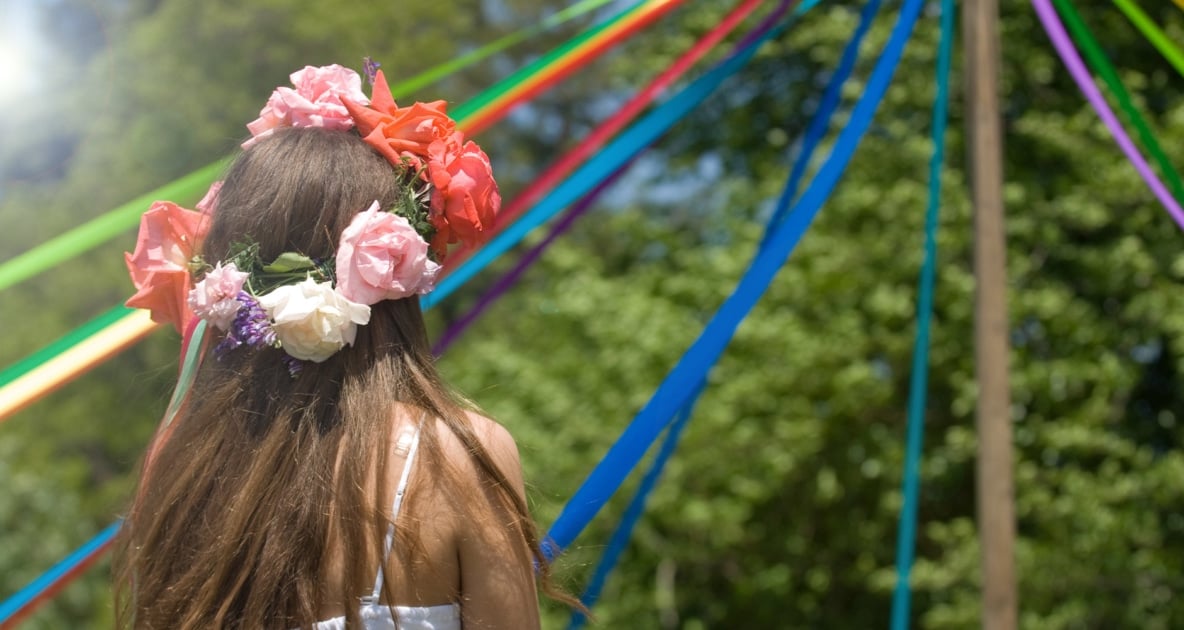
By the Middle Ages, May Day was a secular event, and the most popular way to celebrate it was to dance around the maypole. This is a tradition that is still practiced in parts of Europe and the United States today.
The maypole dance features a large pole, traditionally cut from a birch tree, with dozens of ribbons fastened to the top. Each dancer takes a ribbon and moves around the pole in a set pattern with the rest of the dancers. The goal is to cover the pole in pretty woven designs. This was a particularly popular event in Great Britain, to the point that nearly every village cut its own maypole for May Day. Some villages would even compete to see who had the tallest one.
Other traditions include crowns of flowers and the crowning of the May Queen. Rarely, observers of this holiday will crown a king, too.
It is worth noting that May Day celebrations, both past and present, are a tradition of people in the Northern Hemisphere. In the Southern Hemisphere, May marks the onset of winter, so the season the holiday welcomes runs the other way around.
See a Maypole dance celebration from Illinois
May Day Traditions Around the World Today
The maypole is far from the only way the first of May gets marked. Over the centuries, each region kept the fertility-and-flowers heart of the day and dressed it in local custom. A few traditions you may still run across:
- May baskets in the United States. Children once filled small baskets or paper cones with flowers and sweets, hung them on a neighbor’s doorknob, rang the bell, and ran off before they were caught.
- Lei Day in Hawaii. Since 1928, Hawaiians have marked May 1 as Lei Day, a celebration of the flower lei and island culture, summed up in the local saying “May Day is Lei Day.”
- Walpurgis Night in northern Europe. On the eve of May 1, Germany, Sweden, and Finland light large bonfires, a spring-welcoming fire custom that echoes old Beltane.
- Green Man and hobby horse in Britain. Towns like Padstow in Cornwall still parade a costumed ‘Obby ‘Oss and a leaf-covered “Jack in the Green” through the streets to greet the season.
Wherever it lands, the day tends to fall near the Flower Moon, the full Moon of May. You can find its exact date on our full Moon dates and times page.
A Workers’ Holiday?
May Day took on a double meaning in the 1880s. At the time, people all over the world were fighting for fair workplaces, demanding unions and eight-hour workdays among other things. May Day became known as International Workers’ Day because it happened to fall on the anniversary of the Haymarket Affair in Chicago.
On May 1, 1886, protesters organized an event that was supposed to last several days. By May 3, protests were turning violent, culminating in a riot at the McCormick Reaper Works in Chicago. This led to an even larger protest the next day as enraged protesters flocked to Haymarket Square. During the Haymarket demonstration, a bomb went off among police ranks, wounding 67 officers, seven of whom were killed. Police returned fire, wounding more than 200 protesters and killing several. This event would go on to be known as the Haymarket Tragedy. Britannica keeps a detailed account of the Haymarket Affair if you want to read further.
In 1889, the International Socialist Conference, a group fighting for workers’ rights worldwide, declared that May 1 would forever be known as International Workers’ Day, both to commemorate the tragic events of the Haymarket Affair and to help further the cause of workers’ rights around the world. Today more than 60 countries observe May 1 as an official public holiday.
Don’t Confuse “May Day” With “Mayday”
May Day is not to be confused with “Mayday,” which is an urgent call for help, usually said three times in quick succession. The distress signal has nothing to do with the holiday. It comes from the French m’aider, meaning “help me,” and was chosen in the 1920s because it was easy to hear and hard to mistake over a crackling radio.

May Day: Frequently Asked Questions
What is May Day?
May Day is a spring holiday celebrated on May 1 to welcome summer in the Northern Hemisphere. It grew out of pre-Christian festivals like the Gaelic Beltane and the Roman Floralia, both of which celebrated fertility. In much of the world it is also International Workers’ Day, a day set aside for labor rights.
Why is May Day celebrated on May 1?
May 1 sits about halfway between the Spring Equinox and the Summer Solstice, so ancient peoples used it to mark the turn toward summer. The Gaels celebrated Beltane on that date and the Romans held Floralia around the same time. The workers’ meaning was later fixed to May 1 because it lined up with the anniversary of Chicago’s 1886 Haymarket Affair.
What is the maypole dance?
The maypole dance uses a tall pole, traditionally cut from a birch tree, with dozens of ribbons fastened to the top. Each dancer takes a ribbon and moves around the pole in a set pattern, weaving the ribbons into colorful designs down its length. It became the most popular way to celebrate May Day by the Middle Ages and is still practiced in parts of Europe and the United States.
Is May Day the same as International Workers’ Day?
They share the same date but come from different roots. The older May Day is a seasonal festival, while International Workers’ Day was declared in 1889 by the International Socialist Conference to commemorate the Haymarket Affair and advance workers’ rights. Today many countries observe both meanings on May 1, and more than 60 treat it as an official public holiday.
What is the difference between May Day and Mayday?
May Day is the May 1 holiday. “Mayday” is an urgent call for help, said three times in quick succession, and it has nothing to do with the celebration. The distress signal comes from the French phrase m’aider, meaning “help me,” and was adopted in the 1920s because it carried clearly over the radio.
How do people celebrate May Day today?
Traditions vary by place. Some communities still dance the maypole, crown a May Queen, and wear crowns of flowers. In the United States children have left May baskets on neighbors’ doors, Hawaii marks Lei Day, and parts of northern Europe light Walpurgis Night bonfires. Wherever you are, it is a fine excuse to celebrate the return of warm weather.


Amber Kanuckel
Amber Kanuckel is a freelance writer from rural Ohio who loves all things outdoors. She specializes in home, garden, environmental, and green living topics.
- Amber Kanuckel

- Amber Kanuckel
- Amber Kanuckel
- Amber Kanuckel



May Day is a International Workers” Day
Hi Vivianne Vlime, the article does go into great detail about that.
Answer some questions about the 1st Intetnational Day