What Is A Sunspot And A Solar Flare?
Quick Reference
- Sunspot: A cooler patch on the Sun’s surface (8,000 F vs 11,000 F nearby). Looks dark only by contrast.
- Solar flare: A sudden geyser of hot gas from the Sun’s surface. More energy and faster than a coronal mass ejection.
- Cycle: 11 years from minimum to maximum to minimum again. Discovered by Schwabe in 1842.
- Effects on Earth: Aurora borealis, radio blackouts, occasional power-grid disruptions (Quebec 1989, Carrington 1859).
- Almanac use: Sunspot activity is one factor in the long-range forecast formula.
Sunspots and solar flares are making headlines lately, but what are they exactly and how do they affect us here on Earth? Learn how they are believed to influence our weather and even have the power to disrupt communication in the following article.

What Is A Sunspot?
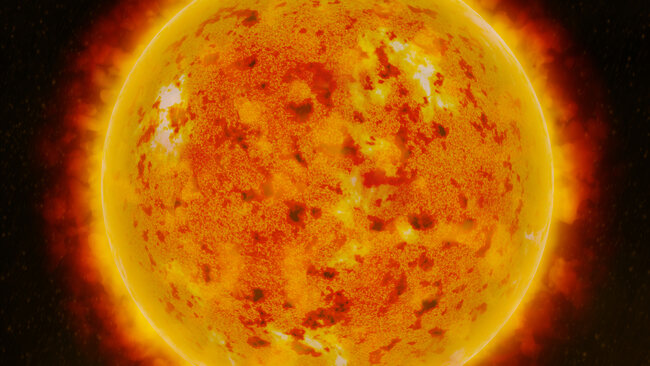
A sunspot is a cooler area on the Sun’s surface (the photosphere) that appears darker because it emits less light than the surrounding areas. A sunspot’s average temperature is about 8,000 F (4,400 C) while the Sun’s photosphere is approximately 11,000 F (6,100 C). But make no mistake about it: If you could somehow lift a sunspot off the Sun’s surface and place it in the sky on its own, it would appear dazzling, as bright as one hundred full Moons.
The dark, irregularly shaped center or “umbra” of a sunspot can range in size from about 900 miles to over 50,000 miles in diameter. This is surrounded by a slightly brighter area called a “penumbra,” which often more than doubles the size of the sunspot and could easily fit a handful of Earths.
What Causes Sunspots?
Although we have been studying sunspots for hundreds of years, their exact cause is still unknown. They have strong magnetic fields and appear to be giant solar storms, which may be caused by deeper, periodic changes.
How Do They Move?
Sunspots frequently swim through the sea of incandescent gases in pairs or clusters. They grow rapidly and then slowly decline. In 1610, Galileo discovered that they seem to move across the solar disk as the Sun turns on its axis. From observations of sunspots, we have deduced that the Sun rotates fastest at the equator, taking 25 days for one full turn, compared to about 29 days near the poles.
In 1842, Heinrich Schwabe of Dessau, Germany discovered a distinct cycle, an 11-year period of increasing and decreasing sunspot activity. Since then, everything imaginable has been examined for a relationship to the 11-year sunspot cycle: the stock market, wars, epidemics, the price of whiskey, and even the fertility of fur-bearing animals in Canada.
What Is A Solar Flare?
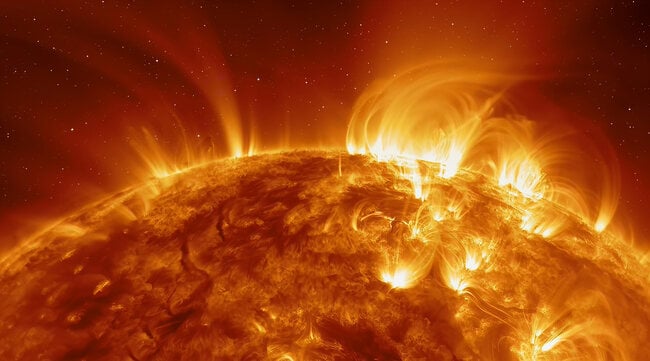
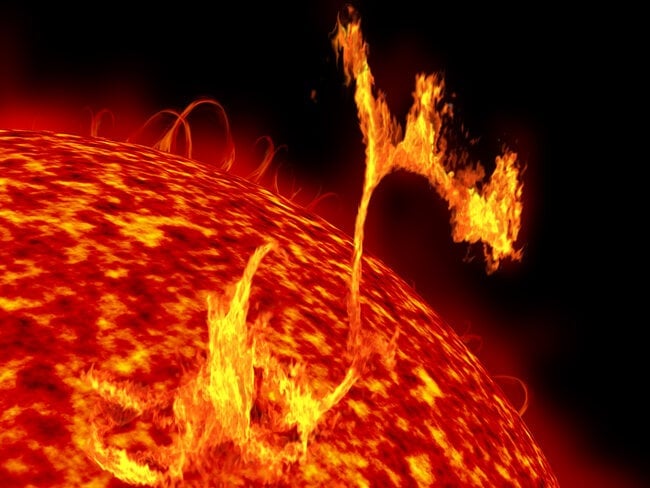
A solar flare is a geyser of hot gases on the surface of the Sun caused by a sudden release of energy. Not to be confused with a coronal mass ejection (CME), a solar flare has much more energy and develops more quickly.
The Connection Between Sunspots And Solar Flares
As a rule, the more spots there are, the more likely there are big flares. Typically, shortly after a flare erupts, great streams of electrified particles rocket through space at speeds of 2 million miles per hour or more, ultimately colliding with the rarefied gases of the upper atmosphere.
These gases can blaze into a colorful battleground of diffuse shifting and glowing lights resembling arcs, streamers, and rays known as the Aurora Borealis or “Northern Lights.” Most auroral displays appear in the arctic regions around the Earth’s magnetic poles, but on rare occasions, an exceptionally large sunspot or solar flare will push its zone of visibility through Canada and down into the central or even the southern United States. (The flare witnessed by Carrington caused the northern lights to be seen as far south as the Caribbean.)
On September 1, 1859, an English astronomer, Richard C. Carrington, was routinely charting sunspots. The solar image in his telescope was filtered to reduce its blinding brightness, but suddenly in one sunspot group, two brilliant spots of light appeared. At first Carrington thought there was a gap in his filter that allowed the passage of full sunlight, but the spots became even brighter. He was the first man to witness a solar flare. Within minutes, the magnetic needles in every observation station throughout the world gyrated in a wild dance. Since then, the correlation of such flares with sunspots has become well-established.
How Do Solar Flares Affect Earth?
Solar flares send surges of electricity into Earth’s atmosphere that may black out radio communications and cause utility company circuit breakers to trip, cutting off power. One such magnetic disturbance occurred in March 1989, shutting down power across Quebec for nine hours. Another instance happened in September 2017, which affected Europe and Africa.
Learn more about radio blackouts due to solar flares. (This link takes you to NOAA.gov.)
Does Solar Activity Affect Our Weather?
Some scientists believe that solar activity does affect our weather. In the late 19th century, two astronomers, Edward Maunder and Gustav Sporer, published papers that pointed to a period between the years 1645 and 1715 when sunspots became exceedingly rare. Interestingly, this same 70-year interval roughly coincided with the middle part of the “Little Ice Age,” during which time Europe and North America experienced much colder-than-average temperatures. A new sunspot cycle is now underway, with the expectation that we will reach a maximum around mid-2025.
Over the past decade, however, astronomers noticed the Sun going through unusually long stretches without any sunspots; even during the most recent solar maximum in 2014, sunspot numbers were 36% below normal. Some scientists think that we might be heading for the start of another prolonged sunspot minimum, like what was experienced 375 years ago, and that another spell of unusually cold weather, some call it “global cooling,” will ultimately result. Others disagree, stating that the lack of sunspots and the Little Ice Age in the late 17th and early 18th centuries was merely coincidental, and that an unusually high level of volcanic activity worldwide, spewing clouds of ash and dust into the atmosphere and thus reducing incoming sunlight, was the real cause of the Little Ice Age.
How About The Farmers’ Almanac Predictions?
Sunspots and solar activity are two factors that are looked at for the Almanac’s long-range forecasts. According to Farmers’ Almanac weather prognosticator Caleb Weatherbee, it is generally assumed that a spell of colder conditions accompany a paucity of sunspots and low solar activity while generally warmer weather occurs when sunspots are more prolific and the Sun is more active. It is a very contentious issue. A former chief of NOAA’s Space Environment Center perhaps best summed it up many years ago when asked what effect solar activity has on Earth’s weather patterns. “If I knew that,” he said, “I would be a millionaire.”
Famous Solar Events
| Date | Event |
|---|---|
| Sept 1-2, 1859 | Carrington Event. Telegraph systems failed, auroras seen in the Caribbean. |
| March 13, 1989 | Quebec blackout. Province-wide grid failure for 9 hours. |
| Oct-Nov 2003 | Halloween Storms. Multiple X-class flares, satellite damage, aurora to Florida. |
| Sept 2017 | X9.3 flare. Radio blackouts across Europe and Africa. |
| May 10-11, 2024 | G5 geomagnetic storm. Aurora seen across the Lower 48 and northern Mexico. |
The NOAA Space Weather Prediction Center publishes daily sunspot counts, flare alerts, and aurora forecasts. The current solar cycle (Cycle 25) peaked in 2024-2025.

Frequently Asked Questions
What is a sunspot?
A cooler area on the Sun’s surface (about 8,000 F vs the surrounding 11,000 F) that appears darker by contrast. The dark central umbra can be 900 miles to over 50,000 miles across.
What is a solar flare?
A sudden geyser of hot gas from the Sun’s surface, releasing far more energy and developing far faster than a coronal mass ejection. Flares typically follow large sunspot groups.
What is the solar cycle?
An 11-year cycle of rising and falling sunspot activity, discovered by Heinrich Schwabe in 1842. The current Cycle 25 peaked in 2024-2025.
How can solar flares affect Earth?
By disrupting radio communications, tripping power-grid breakers, and producing aurora. The 1859 Carrington event and the 1989 Quebec blackout are the most famous examples.
Do sunspots affect Earth’s weather?
Possibly. The 1645-1715 Maunder Minimum coincided with the coldest stretch of the Little Ice Age. Some scientists tie the two together. Others credit volcanic activity for the cooling.
Who first saw a solar flare?
English astronomer Richard C. Carrington on September 1, 1859. Within minutes, magnetic needles at every observation station on Earth gyrated wildly. The event named for him remains the strongest solar storm on record.
Where can I track current solar activity?
The NOAA Space Weather Prediction Center publishes daily sunspot counts, X-ray flare alerts, geomagnetic storm levels, and aurora forecasts.
Join The Discussion!
What is one surprising fact you learned about a solar flare or sunspot?
Let us know in the comments below.


Joe Rao
Joe Rao is an esteemed astronomer who writes for Space.com, Sky & Telescope, and Natural History Magazine. Mr. Rao is a regular contributor to the Farmers' Almanacand serves as an associate lecturer for the Hayden Planetarium in New York City.
- Joe Rao
- Joe Rao
- Joe Rao
- Joe Rao