

7 Types of Rainbows That Remind You Nature is Awesome
Rainbows are even more unique and wonderful than you imagined, these 7 prove you need to be pretty lucky to spot one. See the list.
Quick Reference
- Why so many types: the colors and shape of a rainbow depend on the size of the water droplets, the angle of the light source, the position of the observer, and the surface the light passes through. Different combinations produce different rainbows.
- Most common rainbow: the standard primary rainbow, formed at a 42-degree angle from the antisolar point (the spot directly opposite the sun from your perspective).
- Rarest type on this list: the supernumerary rainbow. It requires uniformly tiny water droplets and is sometimes the first kind of rainbow you have to learn about for it to register as different from the primary bow.
- Best viewing conditions: sun behind you, rain or fog or mist in front, sky relatively clear above. Most U.S. observers can see at least four of the seven types in their lifetimes if they look up after summer thunderstorms.
- Note on circles: all rainbows are full circles. We see arcs because the ground cuts off the bottom half. From an aircraft, the full circle is visible.
Most of us know the standard rainbow: the colorful arch that appears after rain, with the sun at our back and the rain in front. What fewer people know is that the standard arch is just one of seven distinct rainbow types that occur in nature, each requiring its own set of conditions. Some appear only in fog. Some appear only at night. Some are full circles. Some are a single color. Each one is real, each one has been photographed and documented, and each one rewards a sky-watcher who knows what to look for. Here are the seven types of rainbows, the conditions each requires, and how often U.S. observers can expect to see them.
1. The Primary Rainbow (The One Everyone Knows)
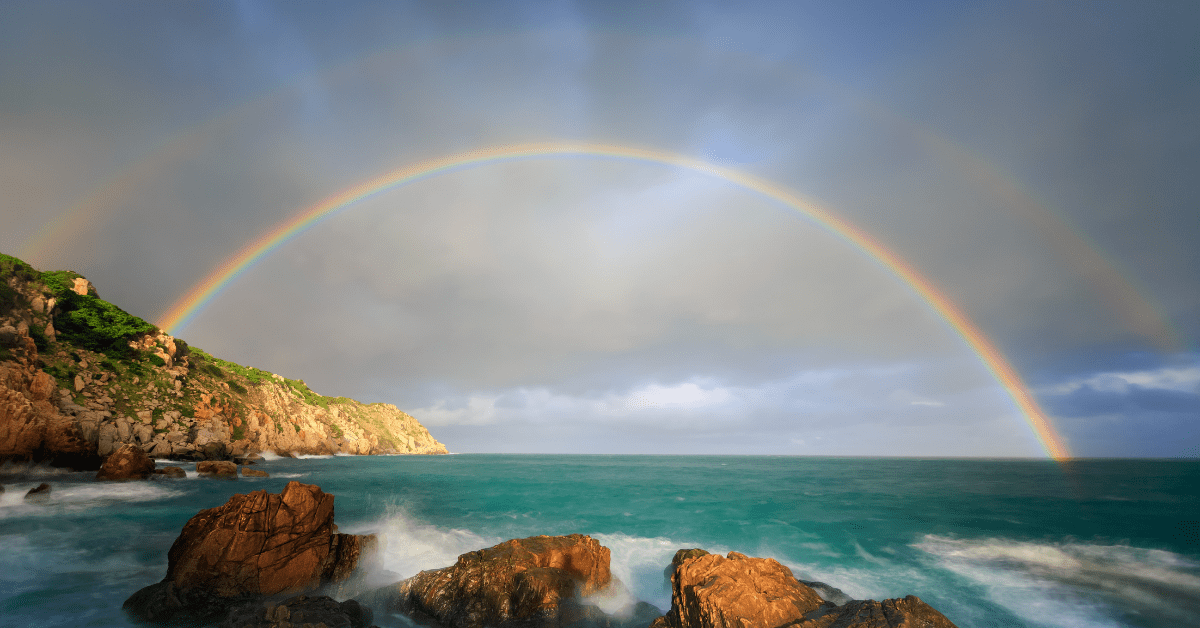
The standard primary rainbow forms when sunlight enters a raindrop, refracts (bends) as it passes from air to water, reflects off the inside back of the droplet, and refracts again on the way out. The result is a 42-degree-angle band of color visible centered on the antisolar point (the point in the sky exactly opposite the sun from the observer). The colors run red on the outside (top) of the bow and violet on the inside (bottom), which is the reverse of the order in a prism because the rainbow is reflected off the inside of the droplet rather than transmitted straight through.
Primary rainbows form whenever the sun is below 42 degrees in the sky and there is rain or mist in the opposite direction. They are most common in the late afternoon when the sun is dropping toward the horizon and afternoon thunderstorms are clearing. They are also visible in the early morning. At local solar noon (when the sun is high in the sky), the rainbow forms below the horizon and is invisible to ground-level observers. For more on the science of the standard bow, see our all about rainbows piece.
2. Double Rainbows
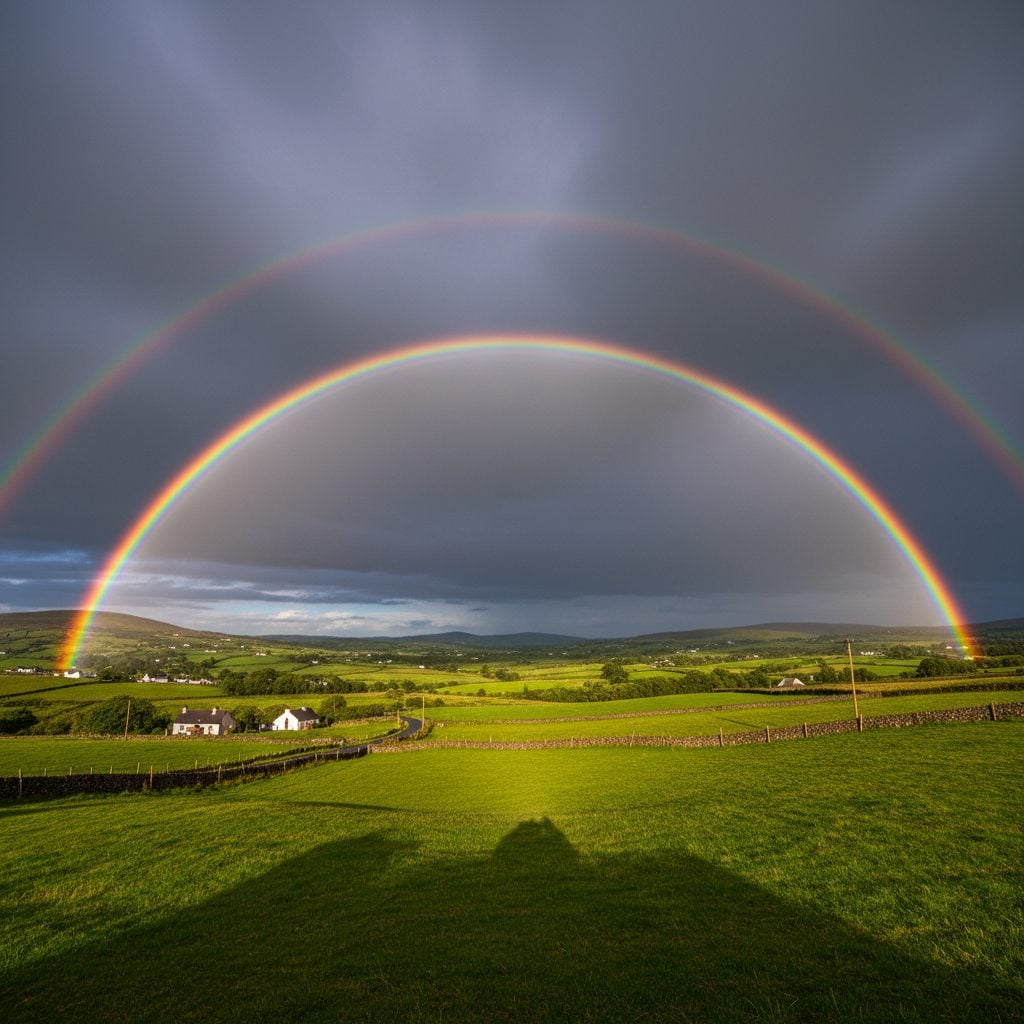
The double rainbow appears when sunlight reflects twice inside each raindrop instead of just once. The second reflection adds about 9 degrees to the angle, so the secondary bow appears at 51 degrees from the antisolar point, outside the primary bow. The colors of the secondary are reversed: red on the inside (bottom), violet on the outside (top). The dark band between the primary and secondary bows has its own name: Alexander’s Band, after Alexander of Aphrodisias, the 2nd-century philosopher who first described it.
Double rainbows are less rare than people think; you will see one a few times a year if you live in a region with active thunderstorm activity. The secondary bow is dimmer because the second reflection inside the droplet loses light, but on a sun-behind-you, dark-sky-in-front afternoon, it is visible to anyone who looks up. The reversed color order is the easy way to confirm a double rainbow: red at the top of the inside bow, red at the bottom of the outside bow.

3. Multiple Rainbows
Multiple rainbows are not the same as a double rainbow. A multiple rainbow event involves three or more separate rainbows arching in roughly parallel positions. The third, fourth, and even fifth bows form when sunlight reflects three or four or more times inside a raindrop before exiting. Each additional reflection further dims the bow, so by the time you reach a tertiary or quaternary bow, the colors are extremely faint and visible only against an unusually dark background sky.
Tertiary and quaternary rainbows are rare. The tertiary appears in the same direction as the sun (around the sun, not the antisolar point) at about 40 degrees from the sun, which makes it almost impossible to spot because the bright sun overwhelms the dim bow. Most documented multiple rainbows are produced when two separate rain showers, each with its own droplet population, contribute to a complex bow pattern. True three-or-more-reflection rainbows are vanishingly rare in nature, more often captured in laboratory conditions than in the field.
4. Supernumerary Rainbows
Supernumerary rainbows are an entirely different optical phenomenon from the standard rainbow types. They appear as faint pastel bands of pink, green, and purple just inside the primary rainbow, and they cannot be explained by simple refraction-reflection geometry. They are caused by wave interference: light passing through small, uniformly sized water droplets produces interference patterns the same way ripples on a pond produce interference when two stones are dropped together.
Supernumeraries require water droplets that are nearly all the same size and very small (less than 1 millimeter in diameter, often closer to 0.5 mm). The size requirement is strict; if the droplets vary in size, the interference patterns from different droplet populations cancel each other out. Supernumerary rainbows are most often observed in mist, light rain, or fog, where the droplets are uniform. Their existence in the early 1800s was one of the first practical proofs of the wave nature of light, helping settle the long debate over whether light travels as particles or waves.
5. Circular Rainbows
Every rainbow is technically a complete circle. The 42-degree angle that defines the primary bow runs the full 360 degrees around the antisolar point, producing a circle in the sky. We see only the upper arc from the ground because the lower half is below the horizon (where there are no raindrops to refract the sunlight, just dirt or pavement or grass). To see the full circle, you need to be high enough above the ground that there are still raindrops below your eye level.
The most common way to see a circular rainbow is from an aircraft. Looking out the window during a flight through scattered rain (or just below a rain shower), you can sometimes see the complete circle of the rainbow projected onto the cloud or rain layer below. The aircraft’s shadow will be at the exact center of the circle, on the antisolar point. The same effect can occur on a much smaller scale with a garden hose mist on a sunny day, where you can see the bottom half of the rainbow appearing on the grass.
6. Monochrome (Red) Rainbows
Monochrome rainbows appear at sunrise and sunset, when sunlight has to travel through more atmosphere to reach you and the shorter wavelengths of light (blue, green, indigo, violet) have been scattered away. Only the red and orange wavelengths survive the long path through dust, water vapor, and air molecules to reach the rain ahead of you. The result is a rainbow with only one or two visible colors at the red end of the spectrum.
Monochrome rainbows are most common during summer evenings, after a thunderstorm has passed and the setting sun is low on the western horizon. They appear in the east, against the departing storm. The effect is the same physics that makes sunrises and sunsets red: Rayleigh scattering of shorter wavelengths preferentially over longer ones. The rainbow is a rare combination of the right scattering conditions plus the right rain location plus the right sun angle, but observers in the Plains and Southeast can expect to see one or two per year if they make a habit of watching the sky after late-day storms.
7. Moonbows (Lunar Rainbows)
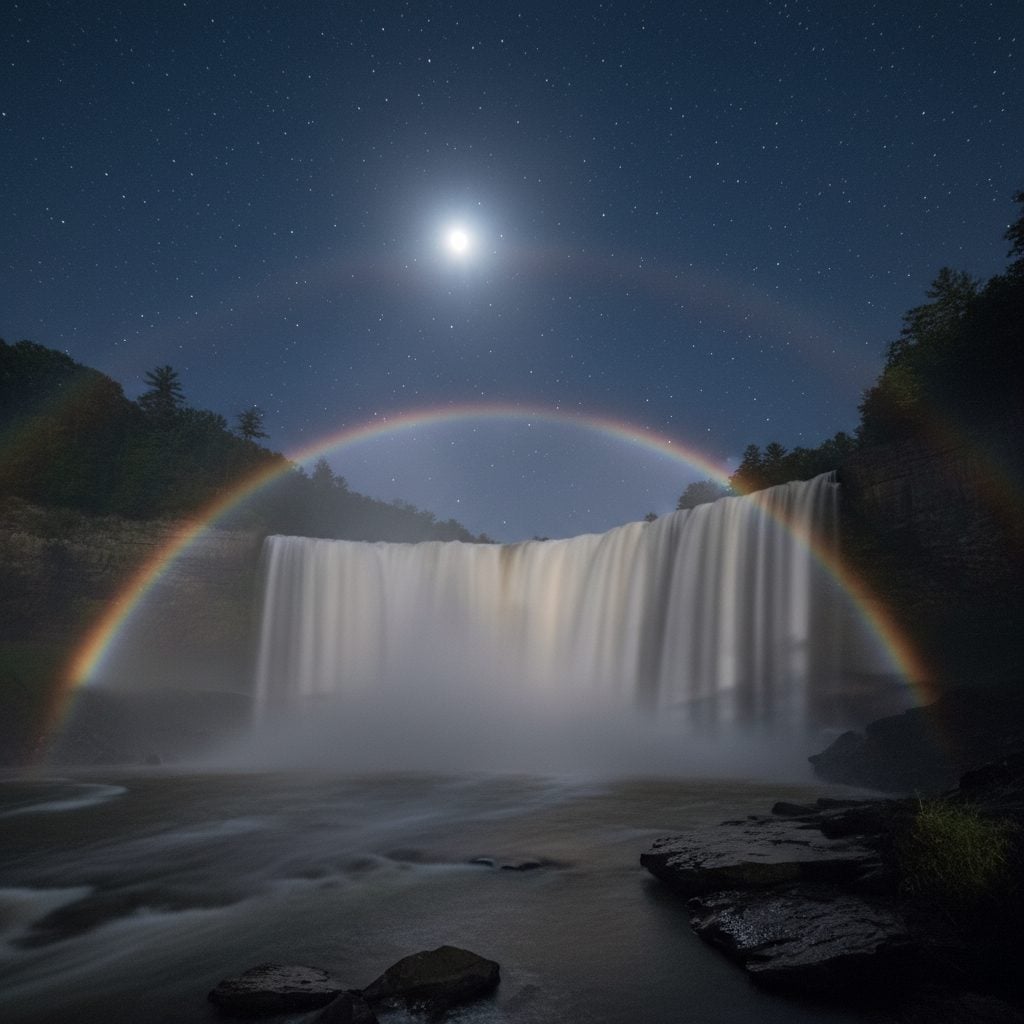
Moonbows form by exactly the same physics as solar rainbows, but with moonlight instead of sunlight. Moonlight is reflected sunlight that has bounced off the moon, and a full moon is bright enough to produce a faint visible rainbow when conditions are right. The colors are the same as a solar rainbow, but they appear so dim that human color vision often perceives the moonbow as a white or grayish arc rather than a colored one. With a long-exposure photograph, the colors are clearly visible.
The conditions for a moonbow are demanding: a full or near-full moon, a clear sky in the moon’s direction, rain or mist in the opposite direction, and the moon at a low enough angle (under 42 degrees) for the moonbow to form above the horizon. The most reliable place in the world to see moonbows is at Cumberland Falls in Kentucky, where the spray from the waterfall produces moonbows on most clear-night full moons throughout the year. Other reliable spots include Niagara Falls and Yosemite Falls. For more on lunar rainbow viewing, see our moonbow piece.
Bonus: Fogbows (Ghost Rainbows)
Some sky-watchers count fogbows as the eighth type, but the simpler categorization treats them as a special subtype of rainbow that occurs in fog rather than rain. A fogbow forms when sunlight passes through tiny fog droplets (usually 0.05 mm or smaller, much smaller than typical raindrops). The droplet size produces wave interference effects that wash out most of the colors, leaving the fogbow as a wide, pale, mostly-white arc. Some fogbows have faint pink at the outer edge and faint blue at the inner edge.
Fogbows form when the sun is at a low angle (under 30 degrees) and there is dense fog ahead of you. They are most common in coastal areas (Pacific Northwest, New England, Northern California, the Maritimes), in mountain valleys with morning fog, and at high altitudes where clouds form below your viewing position. The “ghost rainbow” nickname comes from the pale, washed-out appearance.
Other Rainbow-Adjacent Sky Phenomena
The seven types listed above are the rainbow types that follow the same basic geometry (light bending through water droplets, refracting, reflecting, exiting). Several other sky phenomena look rainbow-like but are produced by different optical mechanisms, and they get confused with rainbows often enough to be worth listing.
- Sun halos: 22-degree rings around the sun caused by ice crystals in high cirrus clouds, not water droplets. Whitish or pale-colored. See our sun halo piece.
- Sun dogs: bright spots about 22 degrees on either side of the sun, also produced by ice crystals. Often colored.
- Coronas: small, thin rings of color tightly around the sun or moon, caused by water droplets in thin clouds (not raindrops).
- Glory: a series of colored rings centered on the antisolar point, often seen from aircraft windows around the aircraft’s shadow on a cloud below.
- Iridescent clouds: patches of color in cumulus clouds caused by diffraction of sunlight through cloud water droplets, often seen near the cloud edges.
None of these is a rainbow, technically. They are halos, coronas, glories, or iridescence. The mechanisms are different (ice crystals or diffraction rather than rainbow refraction-reflection in water droplets), and the geometry is different (centered on the sun rather than the antisolar point in most cases). Identifying which phenomenon you are looking at takes a few minutes of practice, and a sky-watcher who learns the difference will start seeing them everywhere.
How to Improve Your Rainbow-Spotting Odds
Most U.S. observers can see at least four or five of the seven rainbow types in a lifetime, often without making any special effort. A few habits make it more likely:
- Look up after late-afternoon thunderstorms. The sun is dropping toward the horizon as the rain is moving east. The geometry is right for primary, double, and monochrome rainbows.
- Watch in coastal fog. The Pacific Northwest, Northern California coast, and New England produce some of the country’s most reliable fogbows during summer-morning marine layer events.
- Visit Cumberland Falls or Niagara on a full-moon night. The mist from the falls plus the bright moonlight produces moonbows on most full-moon nights with clear skies.
- Carry a polarizing filter. A polarizing filter on a phone or DSLR camera enhances the contrast of any rainbow, including faint moonbows and supernumerary fringes that are hard to see with the naked eye.
- Look out the airplane window during rainy approaches. Circular rainbows are most accessible to observers in flight, especially during scattered rain showers near the ground.
For deeper reading on the optical physics behind every rainbow type, the British atmospheric optics scientist Les Cowley maintains an extensive reference at atoptics.co.uk with photographs, geometry diagrams, and the underlying math for every variant of rainbow and rainbow-adjacent phenomenon. For the broader weather context (when after-storm rainbow conditions are most common in your region), the Farmers’ Almanac long-range forecast tracks the seasonal patterns that produce the storms that produce the rainbows.
The next rainbow you see, look at it twice. The second look is where the type-spotter learns the trade.

Frequently Asked Questions
How many types of rainbows are there?
Seven main types: primary, double, multiple, supernumerary, circular, monochrome, and moonbow. Some classifications include fogbow as an eighth type. Several other sky phenomena (sun halos, sun dogs, coronas, glories, iridescent clouds) look rainbow-like but are produced by different optical mechanisms.
Are all rainbows actually circles?
Yes. Every rainbow is a full 360-degree circle around the antisolar point. We see only the upper arc from ground level because the lower half is below the horizon, where there are no raindrops. The full circle is visible from an aircraft.
What is the rarest type of rainbow?
The supernumerary rainbow is the rarest because it requires uniformly sized water droplets, a strict condition that fog and mist meet more reliably than rain. True tertiary and quaternary rainbows (three or more reflections) are even rarer but are typically classified under the multiple-rainbow umbrella.
Why is a double rainbow’s color order reversed?
Light reflects twice inside the raindrop instead of once, which inverts the color order on the way out. The primary rainbow has red on the outside (top); the secondary rainbow has red on the inside (bottom).
Can I see a moonbow without going to a waterfall?
Yes, but it is much harder. Moonbows require a full or near-full moon plus rain or mist plus a clear sky in the moon’s direction. Waterfalls produce the right mist year-round, which is why Cumberland Falls and Niagara are reliable. In open landscape, you would need a lucky coincidence of full moon and active rain shower at low moon angle.
Are fogbows the same as rainbows?
Same physics, different droplet size. The water droplets in fog are much smaller than raindrops, which produces wave interference effects that wash out most of the colors. The fogbow appears as a wide, pale, mostly-white arc with hints of color at the edges.
Can I make my own rainbow?
Yes. Spray a fine mist with a garden hose on a sunny day with the sun behind you. The mist will produce a small primary rainbow at the standard 42-degree angle. With a fine enough mist on a high-pressure setting, you can sometimes see the bottom half of the circle below your eye level on the grass.


Amber Kanuckel
Amber Kanuckel is a freelance writer from rural Ohio who loves all things outdoors. She specializes in home, garden, environmental, and green living topics.
- Amber Kanuckel

- Amber Kanuckel
- Amber Kanuckel
- Amber Kanuckel




I saw the Supernumerary rainbow today!
Wow, how exciting! If you have any photos, please share them here! (Click on the little photo icon above “Post Comment” button.)
I saw a white rainbow about a year ago! We were on a tour bus on a mountain side in Santorini, Greece. It was early evening. I am the only one who saw it so, of course, everyone else joked about it. Except me, I know what I saw, and it was gorgeous! So sorry I didn’t think to snap a pic.
We believe you, Bernie! That must have been an amazing sight. Best wishes from all of us at FA. 🧡
I believe you. I saw pink lightning once and no one believed me either until a friend who had lived in different places said that it was tornado weather. 🩷🌪😳
I was at the end of a rainbow once. The colors were touching the ground. Unfortunately, I was on the wrong side of the rainbow, there was no pot of gold there.
I’ve seen that, too! Could not find that pot of gold though.
I’ve seen one or two double ranbows in my life.
Thanks for sharing your experience, Rob. Double rainbows are special!