

Spotted Lanternfly: How to Identify and Stop the Spread
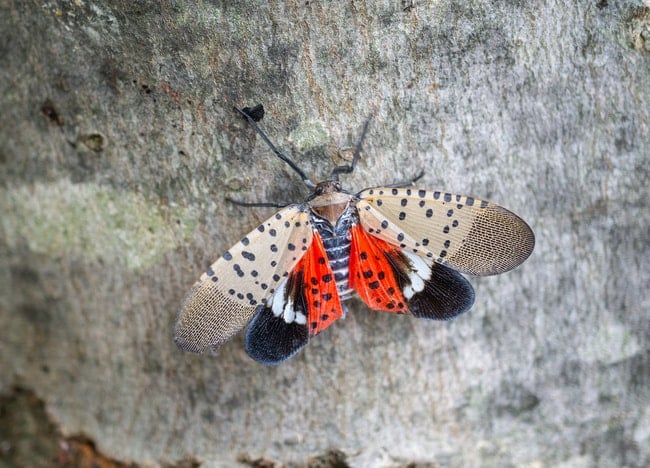
Quick Reference: The Spotted Lanternfly
- What it is: an invasive planthopper, black and red with distinctive spots, that feeds on the sap of crops and trees.
- Why it matters: it damages grapes, apples, peaches, and hardwoods, and secretes honeydew that grows black sooty mold.
- Best time to act: destroy egg masses in fall, winter, and early spring, before they hatch in May.
- Egg masses: gray, putty-like patches that darken to look like dried mud, tire tracks, or bark. Each holds 30 to 50 eggs.
- How to help: scrape and destroy eggs, remove tree-of-heaven, check your car when you travel, and report sightings to your state Department of Agriculture.
The spotted lanternfly is on the move again this summer, and a few minutes of work in your own yard can help slow it down. This black and red planthopper feeds on the sap of crops and fruit trees and has spread across the Northeast and Midwest since it first turned up in 2014. The single most useful thing a homeowner can do is destroy the egg masses in fall and winter, before the nymphs hatch in May. Here is how to spot a spotted lanternfly, what its eggs look like, and how to do your part to keep it from spreading.
Why the Spotted Lanternfly Is So Dangerous
The spotted lanternfly has spent recent summers on the U.S. Department of Agriculture’s most-wanted list of invasive pests, tracked by its Animal and Plant Health Inspection Service (APHIS). These black and red bugs, marked with distinctive spots, have spread like wildfire through the Northeast and Midwest, destroying crops and fruit trees and becoming a serious agricultural threat.
They feed on the sap of cash crops such as grapes, which threatens California’s wine country, along with apples, peaches, and a wide range of trees. Do not be fooled by this bite-free, sting-free insect. Its sucking mouthparts drain the plant, causing wilting and dieback of host plants and reducing crop quality and yield. To make matters worse, as they feed they secrete a sugary substance called honeydew, which feeds the growth of black sooty mold. That mold can attract still more pests and do further damage to trees.
How to Identify a Spotted Lanternfly
Knowing the spotted lanternfly at each stage of its life makes it far easier to stop. According to Penn State Extension, which has tracked this pest since it arrived, the insect passes through several stages between spring and fall. Learning the shapes and colors below helps you catch it early, when your effort counts the most.
- Early nymphs (spring to early summer): small and black with bright white spots, about the size of a pencil eraser.
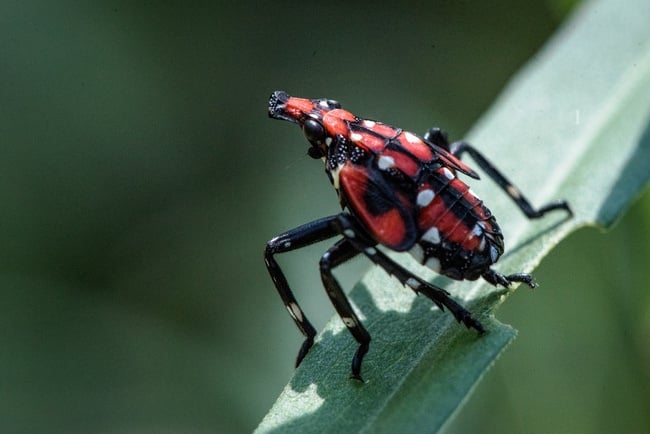
- Late nymphs (mid to late summer): red with black patches and white spots, and larger, roughly a half inch long.
- Adults (late summer into fall): about one inch long with gray forewings dotted in black, and hidden red hindwings that flash when they move.
- Egg masses (fall through spring): gray, putty-like patches on bark and flat surfaces that darken over time.
The adults are not strong flyers. They climb tall structures, then hop or glide downward into air currents to reach the next tree. If you see one insect, look for more nearby, since they tend to gather in groups on trunks and posts.
History: Where the Spotted Lanternfly Came From
The spotted lanternfly was first spotted in the United States in 2014 in Pennsylvania. Experts believe it arrived on a shipment from China a couple of years earlier, and it has since spread to over a dozen states. Residents across the Northeast and Midwest have been besieged by infestations. With no natural predators here, the insect quickly moved into suburban and urban areas, and people have even watched it swarm the sides of tall buildings. It is not alone on the list of unwelcome arrivals, and our roundup of invasive species that wreak havoc puts it in good company with a few other troublemakers.
Where It Has Spread
The spotted lanternfly took hold in southeastern Pennsylvania and has fanned out from there, mostly along shipping routes and highways where egg masses hitch a ride. The map below is a plain-English picture of the spread, not a county-by-county quarantine list, so check with your own state Department of Agriculture for the latest boundaries near you.
A note for readers in the North: a hard winter helps, but it is no cure. Frigid temperatures kill the adults, yet the eggs ride out the cold just fine. Our look at whether cold winters kill bugs explains why the egg masses are the ones that matter, even after a brutal January.
How to Do Damage Control
During the summer, many people encourage others to kill these nuisances on sight. That feels satisfying, but it likely will not put a dent in their exploding population, because these pests are very good at reproducing.
Frigid temperatures do kill adult spotted lanternflies, which brings temporary relief for some. Do not celebrate quite yet. Spotted lanternflies mate and lay eggs through October and November, and they keep reproducing until the first hard freeze. Before they die off, they deposit eggs that stay intact through the winter. Tiny nymphs then hatch as the weather warms, ready to threaten more trees and crops.
This is why experts encourage destroying clusters of eggs in the fall, winter, and early spring, before hatching begins in May. Penn State Extension keeps a current, plain-English guide to managing the spotted lanternfly if you want step-by-step help for your property. A tidy yard also helps: some of the same habits that keep other garden bugs away make your space less inviting to this one.

What Do Spotted Lanternfly Eggs Look Like?
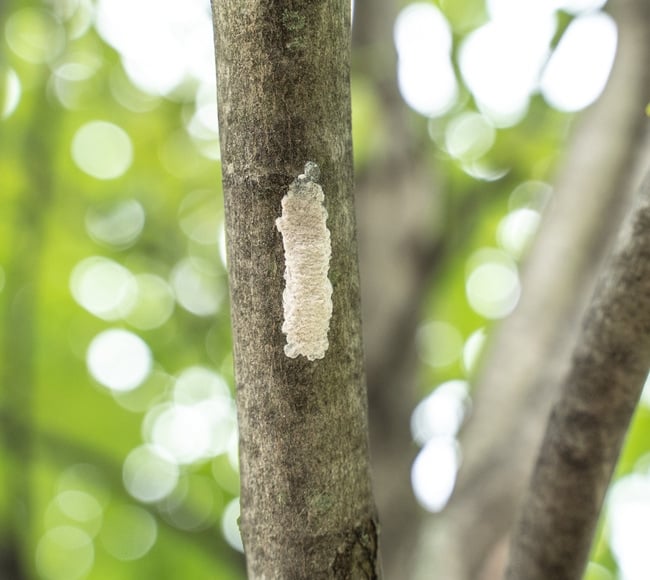
During the fall, spotted lanternflies deposit their eggs in masses on the sides of trees, pallets, firewood, outdoor furniture, and other flat objects. Egg masses start out looking like small spots of gray, putty-like material with a waxy coating.
Over time they darken to resemble dried mud or mold on a tree. Egg sacs can also look like tire tracks. Each mass contains 30 to 50 eggs, so every one you destroy in winter is dozens of nymphs that never hatch in May.
How to Dispose of Eggs in Fall and Winter
Stomping out single adults one at a time is all well and good, but the goal is to eliminate the egg masses so you do not have to battle the adults later. Fall and winter is the time to do this. Walk your property and check for signs of lanternfly eggs, then destroy them. Look over outdoor playsets, toys, garden tools, machinery, and patio furniture before you store them away for the season.
Experts recommend using a rock or a credit card to crush the egg mass while you scrape it off the tree and into a bag or container. Add a little hand sanitizer, rubbing alcohol, or bleach to the bag to kill the eggs before you dispose of it. You can also wrap sticky tape around tree trunks, fence posts, rocks, or wherever these bugs lay eggs, then discard the tape once it fills with dead insects. Many experts warn about this method, though, since the tape can also trap small, harmless creatures. Adding wire netting or a cage around the tape helps keep small birds and animals out.
- Scrape the egg mass into a sealable bag or container.
- Add hand sanitizer, rubbing alcohol, or bleach to kill the eggs.
- Seal the bag and throw it away.
- Check outdoor gear, furniture, and tools before storing them.
- If you use sticky tape, cage it with wire netting to spare birds and small animals.
Spotted lanternflies are also efficient hitchhikers, climbing onto clothes, luggage, and cars. When you travel, especially to an area with a known infestation, check yourself and your vehicle for stowaways so you do not give one a ride home. These pests like to lay eggs on tires, car bumpers, and grilles, so avoid parking under trees or bushes in areas known to be infested.
Remove the “Tree of Heaven”
While the spotted lanternfly is a serious pest for many trees and crops, its preferred host is the tree-of-heaven, a fast-growing invasive import from China. Beyond being this pest’s favorite food, the non-native tree is known for thriving in urban settings and for being hard to control.
The tree-of-heaven is a damaging plant in its own right, crowding out native vegetation and holding back the growth of neighboring plants. Clearing it from your yard helps your other plants and removes a favorite food source for the spotted lanternfly at the same time.
Learn more about how to control tree-of-heaven in the following video, produced by Penn State Extension:
Collective Action Is Key
Individual combat will not eradicate the spotted lanternfly, but collective action can curb its spread and give nature some needed time to catch up. Experts warn that if the spread is not slowed, the insect could reach and severely damage California wine country within the next few years.
If you spy a spotted lanternfly on your property, tell your state Department of Agriculture so officials can keep monitoring this vexing insect. The same neighborly reporting helps with other newcomers, too, like the giant Joro spider that has people talking across the Southeast. Every report puts another set of eyes on the map.

Spotted Lanternfly: Frequently Asked Questions
What is a spotted lanternfly?
The spotted lanternfly is an invasive planthopper, black and red with distinctive spots, that feeds on the sap of crops and trees. First found in the United States in 2014 in Pennsylvania, it damages grapes, apples, peaches, and hardwoods, and secretes a sugary honeydew that grows black sooty mold.
How do I get rid of spotted lanternfly eggs?
Use a rock or a credit card to crush and scrape the gray, putty-like egg mass off the surface and into a sealable bag. Add hand sanitizer, rubbing alcohol, or bleach to kill the eggs, then seal the bag and throw it away. Do this in fall, winter, or early spring, before the eggs hatch in May.
What do spotted lanternfly eggs look like?
Fresh egg masses look like small patches of gray, putty-like material with a waxy coating. Over time they darken and can resemble dried mud, mold, or even tire tracks on bark and flat surfaces. Each mass holds 30 to 50 eggs, so destroying one in winter stops dozens of nymphs.
Should I kill a spotted lanternfly if I see one?
Yes, killing adults on sight is encouraged in infested areas, but it will not stop the population on its own since they reproduce so quickly. The bigger win is finding and destroying egg masses in fall and winter. If you are in a newer area, report the sighting to your state Department of Agriculture first.
Does cold weather kill the spotted lanternfly?
Frigid temperatures kill the adults, which is why they die off after the first hard freeze. The eggs, however, survive the winter and hatch when the weather warms. That is exactly why fall and winter are the best times to hunt down and destroy egg masses.
What should I do if I find a spotted lanternfly in a new area?
Take a photo, note the location, and report it to your state Department of Agriculture so officials can track the spread. If you can safely destroy the insect or its egg mass, do so. Check your car, especially the tires, bumper, and grille, before driving out of the area so you do not carry it somewhere new.
Join the Discussion
Have you ever seen a spotted lanternfly before? Will you be searching your property for their eggs this fall? Let us know in the comments below.


Natalie LaVolpe
Natalie LaVolpe is a freelance writer and former special education teacher. She is dedicated to healthy living through body and mind. She currently resides on Long Island, New York, with her husband, children, and dog.
- Natalie LaVolpe

- Natalie LaVolpe
- Natalie LaVolpe
- Natalie LaVolpe





I live in nj and the lantern flies are out of control. There are so many eggs in the bushes and tree.they are babies right now. We have electric fly swatter. They have to come up with something to kill them now before they get bigger. The bushes I share with my neighbor I’ve cut down the bushes very short, but I’m doing my part on my side, but if he doesn’t take care of the lanternflys on his side, I just can’t keep up with this someone needs to help us. I’m ready to burn the bushes but can’t do anything because they’re not mine and the tree is not mine. It’s all on his side. Someone please help.
We sure hope your neighbor does his part, for your sake! Best of luck!
A few of the additional gifts from the rotten Communist Chinese Party: Lantern Flies, Tree of Heaven, Covet19. Also Gypsy Moths, Japanese beetles, African honeybees, Killer Hornets, fire ants, pythons, boa constrictors, Tent Caterpillars, Bag Worms, stink bugs, etc, etc,
BAH, HUMBUG. They are all a HUMBUG.
Japanese Tallow trees that we’ve always called Chinaberries drive me nuts ever since I’ve learned they are invasive. Impossible to eradicate them on my property. It’s like a hydra. You cut one, from the stump sprout 20!
I feel that way about Creeping Buttercup. What a beast to get rid of! Good luck in your efforts against your Chinaberry.
My family walks around with fly swatters looking for these guys. We kill them by the thousands.
Why not show picture of tree of heaven, and more pics of eggs. Ones I have seen in NJ don’t look like that. Glad you told of alcohol over egg mass to kill after removal. Many people are just scraping nest off tree.
That’s what I was thinking. They say learn how to tell, and then have one picture and a video. I don’t watch the videos. I would look at 20 pictures though! Different angles, up close, different places, etc.
Helpful article! While I haven’t seen any critters, the Tree of Heaven is quite abundant here in southeastern Va.(Chesapeake/Virginia Beach). I will now be on the lookout for the eggs!
Found a large swarm on my property in Garden MI. Will begin searching for eggs.
Saw dozens in Middletown, New Jersey train station. August.
Reported it and yes one was inside the train going to New York City!
Hi Robert! Yes, the population is exploding. We hope our article gave you helpful information. Thanks for sharing what you saw with us! Please stay in touch by joining our mailing list: https://www.farmersalmanac.com/newsletter
Yikes!