

Planet Parade: What It Is, the 2025 Lineup, and the Next One to Watch For
Quick Reference: Planet Parades
- What it is: three or more planets visible in the same patch of sky at once.
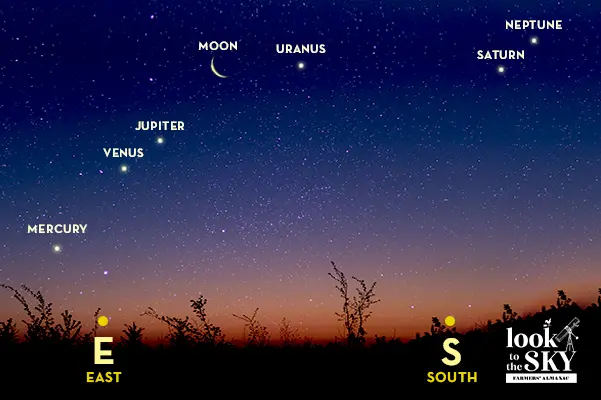
- January 2025 parade: 6 planets (Venus, Mars, Jupiter, Saturn, Uranus, Neptune) in a sweeping line across the evening sky.
- Why it’s special: alignments of this many planets happen only every few decades.
- Naked-eye visible: Venus, Mars, Jupiter, Saturn (4 of the 6).
- Telescope needed: Uranus, Neptune.
- Next big parade: February 2026 (4-5 planets), and February 2034 (6 planets).
In January 2025, six of the eight planets in our solar system lined up in a sweeping arc across the evening sky. Stargazers called it a planet parade, and it was the most-watched alignment of the decade. Here’s what a planet parade actually is, what happened in January 2025, and when the next big lineups will be visible.
What Makes It a ‘Parade’
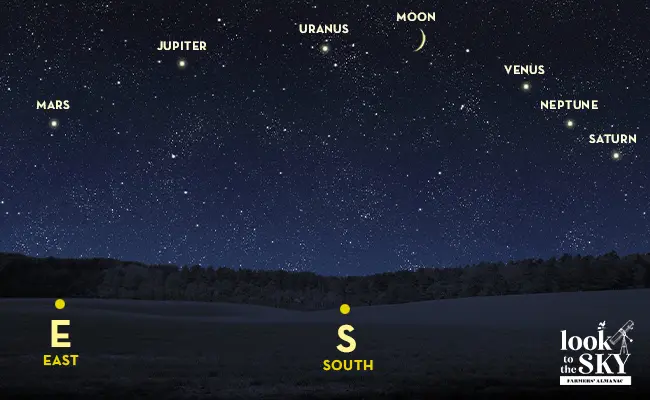
A planet parade is informal shorthand for three or more planets visible in the same patch of sky on the same night. The planets aren’t actually lined up in space; they just happen to be on the same side of the sun from Earth’s viewpoint. The visual effect is a series of bright planet-like ‘stars’ tracing across the sky, often along the ecliptic line.
Parades of 3-4 planets happen a couple times per year. Parades of 5-6 are rare, on the order of once a decade. The January 2025 parade was the first 6-planet alignment since 2002.
The January 2025 Lineup
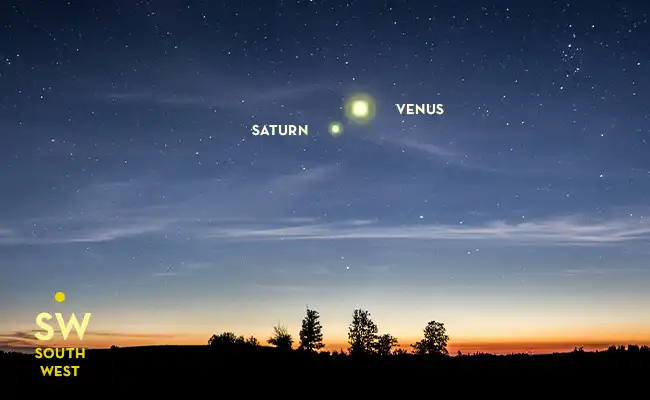
The brightest planets (Venus, Jupiter, Mars) anchored the parade in the early evening sky. Saturn was visible to the unaided eye in the southwest. Uranus and Neptune required binoculars or a small telescope but were in the same general arc.
- Venus: brilliant in the west after sunset, magnitude -4.6.
- Saturn: low in the southwest, magnitude +1.0.
- Neptune: very faint, between Venus and Saturn. Binoculars only.
- Jupiter: dominant overhead, magnitude -2.7.
- Uranus: near Jupiter, very faint to naked eye.
- Mars: bright in the east, magnitude -1.4, rust-red color.
When the Next Parades Happen
Smaller parades come around regularly. Major 5-6 planet parades are rarer.
- February 2026: 4-5 planets visible in evening sky.
- February 2034: the next true 6-planet parade.
- March 2041: a rare 7-planet alignment (Mercury included).
Frequently Asked Questions
How rare is a planet parade?
Three-or-four-planet parades happen 1-2 times per year. Five-or-six-planet parades happen once a decade. Seven or eight planets together is extremely rare, on the order of once a century.
Do the planets actually line up in space?
No. They just appear to line up from Earth’s viewpoint because they’re on the same side of the sun. Their 3D positions in space are far apart.
What’s the best way to see a planet parade?
After sunset on a clear night with a low western horizon. Binoculars help find the dimmer planets. A planet identification app helps identify which dot is which.
Will Mercury be in the next parade?
Mercury joined the 2025 parade in late February when it became visible at sunset, but for only a few days. It will be included in the 2041 alignment.



Dean Regas
Dean Regas is an astronomer and author of seven books including 100 Things to See in the Night Sky and How to Teach Grown-Ups About Pluto and host of the popular astronomy podcast Looking Up with Dean Regas. He can be reached at: www.astrodean.com

This article was published by the Staff at FarmersAlmanac.com. Any questions? Contact us at questions@farmersalmananac.com.
-
Farmers' Almanac Staff

-
Farmers' Almanac Staff
-
Farmers' Almanac Staff

-
Farmers' Almanac Staff


Thank you for your insightful and well written article! Would good binoculars work for seeing Uranus and Neptune? I read something about it someplace. ✨🪐🌟🌜💫
Hi Aris! Thanks for your kind words. Uranus and Neptune can be tough to see! We recommend using a telescope. If you are interested in seeing planets in the night sky throughout the year, save this page: https://www.farmersalmanac.com/visible-planets-guide
Hi Aris. I have seen both Uranus and Neptune through binoculars. Although it does take patience as the conditions have to be perfect.
I recommend closing one eye and just looking through one side, like you would a telescope. Also, I sat on the ground and rested my elbow on my knee to help keep it steady.
Then you have to wait for your eyes to adjust to the dark. I attempted to find Neptune on 6 different nights before I finally spotted it. Worth it though!
I found the Stellarium app really helpful for finding the planets.
It would be cool to see them through a telescope one day! =)
Sometimes it would help if your “sky views” indicated the “seen from” latitude. This would help in the identification of which planet we are actually seeing.
“Moon kisses Uranus” is wild bro