

Winter Weather Forecast 2022-2023: What We Predicted
Quick Reference: The 2022-2023 Winter Weather Forecast
- Season nickname: the Farmers’ Almanac called it a “Shake, Shiver, and Shovel!” winter.
- Coldest stretch predicted: January 16 to 23, with an arctic outbreak we pegged as low as 40 degrees below zero.
- Snowiest zones predicted: the North Central States, the Great Lakes, and the Ohio Valley.
- Mildest area predicted: the Southwest, with near-normal winter temperatures.
- Warm-up: February eased the East, then a lion-like end of March followed the vernal equinox.
This is a look back at the Farmers’ Almanac winter weather forecast we published for the 2022-2023 season, kept here in our weather archive exactly as we called it. We told readers to get ready to “Shake, Shiver, and Shovel!”, and this page revisits that outlook region by region, in past tense, so you can see what we predicted and how the season lined up. Every date, temperature, and regional call below is the one we printed back then.
From the Farmers’ Almanac Weather Archive –
Extended US Winter Weather Forecast 2022-2023
Got flannel? Hot chocolate? Snowshoes? At the time, we told readers it was time to stock up. According to our extended forecasts, the 2022-2023 winter season was set to have plenty of snow, rain, and mush, along with some record-breaking cold temperatures. That is why we warned readers to get ready to “Shake, shiver, and shovel!”
As we predicted, the first bite of winter came earlier than the year before. December 2022 turned stormy and cold nationwide. We expected active storm patterns to keep developing and hang around for most of the season, especially over the eastern half of the country.

Winter Storm Warnings
What we heard more often than not was, how much snow will you get, and when will the winter storm warnings start (and when will they end)? According to our extended forecast, we expected quite a few significant winter weather disturbances nationwide across 2022-2023. A couple of the dates we flagged included:
- The first week of January in the Rockies and across the Plains. During this stretch, we saw good potential for heavy snow that might reach as far south as Texas and Oklahoma, followed by a sweep of bitterly cold air.
- January 16 to 23, when we raised another red flag for bouts of heavy rain and snow across the eastern two-thirds of the country, followed by what might be one of the coldest outbreaks of arctic air we had seen in several years. How cold? Try 40 degrees below zero.
Winter 2022-2023 Forecast, Region by Region
Here is the region-by-region snapshot of what the Farmers’ Almanac predicted for the 2022-2023 winter season across the United States. As always, our long-range forecast worked in broad regions rather than state by state, and it carried our usual honest caveat: the formula runs about 85 percent accurate, and we own our occasional misses.
How Much Snow Did We Say This Winter Season Would Bring?
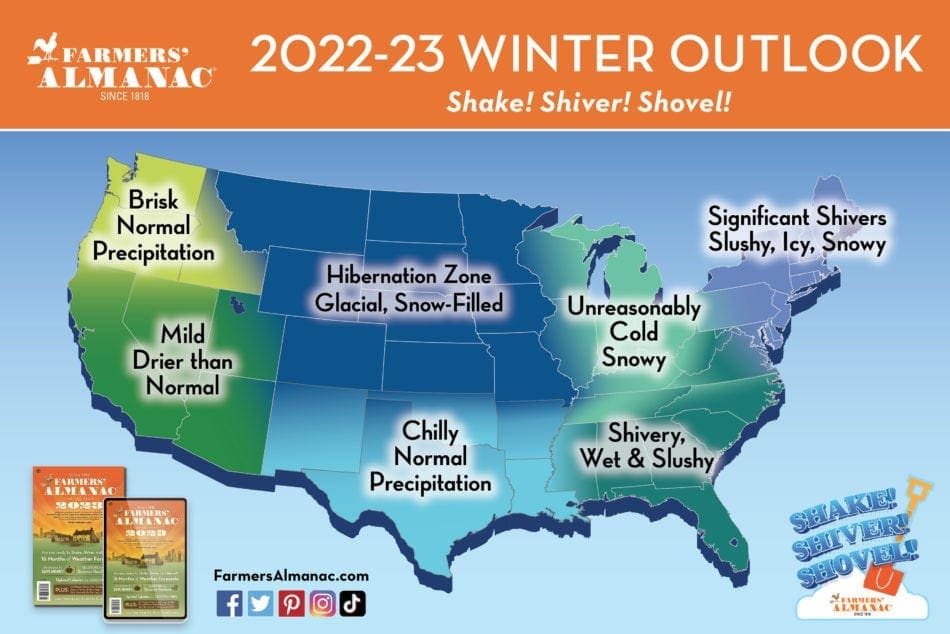
We expected winter 2022-2023 to be dominated by an active storm track in the eastern half of the country, running from the western Gulf of Mexico to the Northeast, across the Virginias, and across interior New York State and New England.
Areas south of the storm track, much of the Southeast, were forecast to see frequent storms bringing cold rains and a wintry mix of wet snow, sleet, ice, and freezing rain, along with chilly temperatures.
The I-95 corridor sat inside this winter mix zone, with places to the north of the track seeing the precipitation fall more as snow, and at times a lot of it. We said that would be especially true over the Ohio Valley and Great Lakes area.
Snow lovers in the North Central States had reason to be happy, since we called for a fair share of storminess through the winter season, which should have meant plenty of snow for winter enthusiasts to enjoy, maybe even in time for a white Christmas.
The South Central States were forecast to see some accumulating snow, especially in early January. The Far West and the Pacific Northwest were set for about-normal winter precipitation, while the Southwest was expected to run less than normal.
How Cold Did We Say It Would Get?
The big takeaway from our winter season forecast was that frigid temperatures should flow into many areas nationwide, especially in the North Central region, where we said readers would certainly be shaking and shivering.
Hot Chocolate Warning In The East And South
A cold December and a very cold January were set to make readers in the Northeast shake and shiver. But we said February would bring milder temperatures that should make the winter seem more bearable.
The Southeast was forecast to feel some shivers, especially during the month of January. Fortunately for the snowbirds, we expected February to warm the region back toward near-normal winter season temperatures overall.
Extra Flannels Necessary In Other States!
We said winter would feel unreasonably cold for readers in the Great Lakes region, especially in January.
Farther south, into the Southern Plains, we expected temperatures to average chillier than normal.
The Pacific Northwest was set for brisk and cool conditions, and the Southwest was our mild area of the country, with near-normal winter temperatures.
When Did We Say It Would Warm Up?
After the vernal equinox, when we should be slipping into spring, we told readers to expect a lion-like end of March. We forecast a wide variety of weather conditions, ranging from heavy snows to torrents of rain to gusty thunderstorms across much of the nation.
How the 2022-2023 Winter Actually Turned Out
Looking back, the season opened much the way our “Shake, Shiver, and Shovel!” headline promised. A powerful arctic outbreak and blizzard swept the country right before Christmas 2022, driving dangerous cold and heavy snow across the Plains, the Great Lakes, and the Northeast, close to the stormy December and eastern storm track we had drawn. The deep-January cold snap we flagged for the 16th to the 23rd was one call where the timing ran ahead of the worst of the season’s chill, a fair reminder that our formula runs about 85 percent accurate and we own our misses.
For the official record of how the winter measured up, the National Oceanic and Atmospheric Administration keeps the monthly climate summaries. You can read NOAA’s January 2023 national climate report to compare the season’s temperatures and precipitation against what we predicted region by region.
More From the Weather Archive
- Farmers’ Almanac Canadian Winter Weather Forecast 2022-2023
- Farmers’ Almanac Weather Archive – Old Farmers’ Almanac Winter Weather Forecasts from winter 2011-12 through winter 2023
- Farmers’ Almanac Winter Weather Forecast US 2023-24
- Farmers’ Almanac Winter Weather Forecast Canada 2023-24

Winter Weather Forecast 2022-2023: Frequently Asked Questions
What did the Farmers’ Almanac winter weather forecast predict for 2022-2023?
We called it a “Shake, Shiver, and Shovel!” winter, with plenty of snow, rain, and mush and some record-breaking cold. We expected an active storm track over the eastern half of the country, the most frigid air in the North Central region, and a milder Southwest with near-normal temperatures.
Which region did the Almanac say would be coldest and snowiest?
The North Central States were pegged for the season’s most frigid temperatures and a fair share of storminess. The Great Lakes and Ohio Valley were set for heavy snow and an unreasonably cold January, while the North Central and Northeast shared the deepest chill.
How cold did the forecast say it would get?
Our biggest cold call landed on January 16 to 23, when we warned of one of the coldest outbreaks of arctic air in several years. How cold? We said try 40 degrees below zero across parts of the eastern two-thirds of the country.
Is the Farmers’ Almanac winter weather forecast accurate?
We forecast in broad regions rather than pinpoint towns, and we have used the same math-based formula for over 200 years. We put its accuracy at about 85 percent and openly acknowledge occasional misses. For 2022-2023, the stormy, cold December and pre-Christmas arctic blast tracked close to our outlook, while the exact timing of the January cold ran ahead of the season’s worst.
When did the Almanac say winter 2022-2023 would warm up?
We told readers February would bring milder temperatures to the Northeast and Southeast, making the winter seem more bearable. After the vernal equinox, we forecast a lion-like end of March, with heavy snows, torrents of rain, and gusty thunderstorms across much of the nation before spring settled in.
Where can I see the current long-range winter forecast?
This 2022-2023 page is an archived forecast. For the season ahead, see the Farmers’ Almanac long-range weather forecast for your region, or browse the weather archive of past winter outlooks going back to 2011-12.


Caleb Weatherbee
Caleb Weatherbee is the official forecaster for the Farmers' Almanac. His name is actually a pseudonym that has been passed down through generations of Almanac prognosticators and has been used to conceal the true identity of the men and women behind our predictions.
- Caleb Weatherbee

- Caleb Weatherbee
- Caleb Weatherbee
- Caleb Weatherbee


How can the farmers almanac predict the weather all year when my local news cant give me a accurate 10 day forecast?
The Farmers’ Almanac weather predictions are based on a formula originally developed in 1818 by our foundering editor, David Young. This formula incorporates many of the various techniques mentioned here, as well as sunspot activity, tidal action of the Moon, the position of the planets, and more. Predictions are tricky business – even with all of the meteorological tools available today!
Hi guys on the map for Great Lakr mid west – Ohio, Indiana area did you all mean UNSEASONABLY COLD, SNOWY – RATHER THAN UNREASONABLY ?
No, last year we called for it being unreasonably cold. This winter the south is expected to be unseasonably cold.
Shouldn’t this be 2023-2024? instead of 2022-2023???
This article is from The Farmers’ Almanac Weather Archive – Extended US Winter Weather Forecast 2022-2023. You can find the current Extended Winter Forecast here: https://www.farmersalmanac.com/extended-forecast
Is this forecast for the winter of 2022-2023 like the title states, or is it actually for the upcoming winter of 2023-2024?
This article is an archive from last winter’s forecast. You can find our current Extended Winter Forecast here: https://www.farmersalmanac.com/extended-forecast