Canes Venatici: The Hunting Dogs Constellation Guide
Learn about some of the dogs roaming the night sky and the job they have in the heavens.
Quick Reference: Canes Venatici
- What it is: A small northern constellation known as the Hunting Dogs, holding the leash for Bootes as he chases the Great Bear.
- Best time to see it: Late April through early July, high in the eastern sky by mid-evening and almost overhead at midnight.
- Where to look: About one-third of the way down from the end of the Big Dipper’s handle.
- Brightest star: Cor Caroli (magnitude 2.8), meaning “Heart of Charles,” named for a Stuart king of England.
- Second star: Chara (Beta Canum Venaticorum, magnitude 4.2), a Sun-like yellow dwarf about 27 light-years away.
- Deep-sky prize: The Whirlpool Galaxy (M51), one of the finest face-on spiral galaxies for a small backyard telescope.
On a clear spring night in 2026, look almost straight up at midnight. Between the crooked handle of the Big Dipper and the bright orange star Arcturus, you will find a quiet patch of sky with only two stars worth noticing. Those two stars, and everything they lead your eye to, make up the constellation Canes Venatici, better known as the Hunting Dogs. Small as it is, this little constellation carries one of the sky’s best cosmic legends and hides one of the finest galaxies you can catch with a backyard telescope.
Canes Venatici: The Hunting Dogs in the Sky
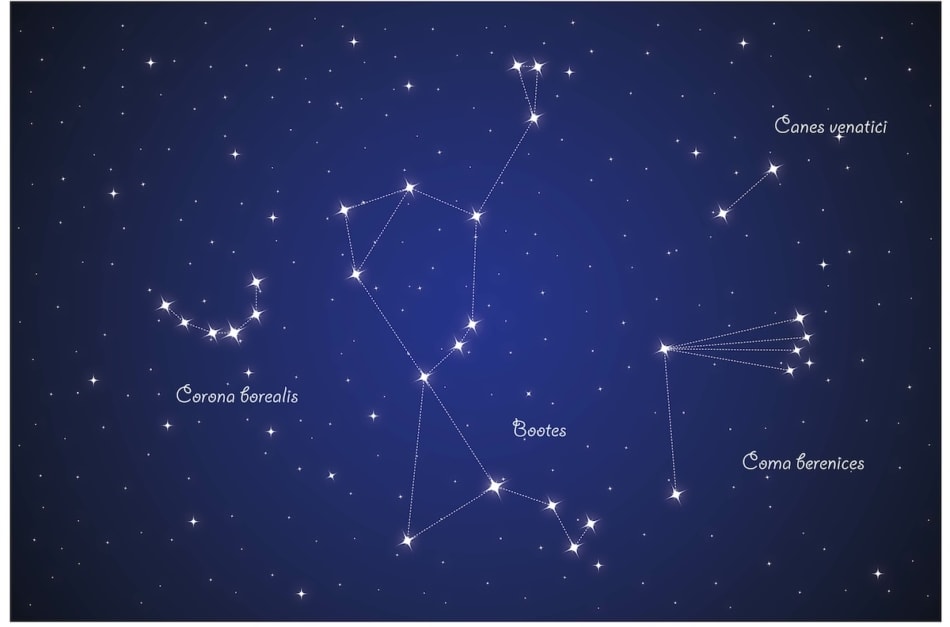
Canes Venatici sits high in the eastern sky through the mid to late evening in spring, and stands almost directly overhead around midnight. Its two main stars mark the position of two celestial dogs held on a leash by Bootes, the Bear Driver. Their job in the old star maps is simple: help Bootes chase the constellation Ursa Major, the Great Bear, on her nightly march around the celestial pole. Once you learn where the Big Dipper’s handle points, the Hunting Dogs are easy to find. Drop a short line from the end of the handle, roughly one-third of the way down toward Coma Berenices, and the two dogs are right there in the gap.
How to Find Canes Venatici Tonight
You do not need a telescope to find the Hunting Dogs. You need a clear northern horizon, a dark sky away from streetlights, and about five minutes of patience for your eyes to adjust. Face north, find the Big Dipper (it will be high up in April, May, and June), and follow the curve of the handle. The Hunting Dogs sit just south of the last two stars of that handle.
- Best months: April through June, with peak height in May.
- Best time: 10 p.m. to 1 a.m. local time.
- Naked-eye view: Two stars. Cor Caroli is easy. Chara takes a moment.
- Binocular view: Both stars plus a scatter of faint field stars.
- Telescope view: The Whirlpool Galaxy (M51) sits at the very top of the constellation.
Cor Caroli: The Heart of Charles
There are only two stars that mark the Hunting Dogs, and Cor Caroli is the brighter of the two. It is known as “the Heart of Charles.” According to a popular story, the star was named by Edmund Halley in honor of King Charles II of England. The suggestion to name it came from Sir Charles Scarborough, the court physician, who claimed that “it shone with a special brilliance on the eve of the King’s return to London on May 29, 1660.”
Look closer at the history, though, and the story turns. The star’s original name was Cor Caroli Regis Martyris, or “Heart of Charles the Martyred King,” a tribute to Charles I, who was executed in 1649. Cor Caroli marks the position of Chara, one of the two hunting dogs in the mythological picture. The other dog, named Asterion, is marked by the second, fainter star of the constellation.
Modern astronomy has added a layer to the folklore. Cor Caroli is a double star, easy to split even in a small backyard telescope, and its brighter component is one of the first stars ever discovered to have an unusually strong magnetic field, according to NASA. The field is so strong that the star’s surface chemistry changes as it rotates.
Chara: The Second Hunting Dog
The dog on the leash beside Cor Caroli is a much quieter star called Chara, the formal name for Beta Canum Venaticorum. It is roughly magnitude 4.2, easily visible under a rural sky but tricky from most suburbs. Chara is a Sun-like yellow dwarf about 27 light-years from Earth, close as neighbors go, and one of the reasons astronomers keep coming back to this constellation.
Deep-Sky Wonders: Galaxies Inside the Hunting Dogs
Small constellation, huge galaxy count. Canes Venatici sits well above the plane of our own Milky Way, so when you point a telescope at it, you look straight out into intergalactic space. That is why so many of the sky’s brightest galaxies live inside it.
| Object | Type | Magnitude | Distance (light-years) | Best viewed with | Notable feature |
|---|---|---|---|---|---|
| M51 / NGC 5194 (Whirlpool Galaxy) | Interacting spiral galaxy | 8.4 | ~27 million | 7×50 binoculars show a faint smudge; 4-inch telescope reveals the core; 8-inch or larger shows spiral arms and companion NGC 5195 | One of the most photogenic interacting galaxy pairs in the sky; NGC 5195 (magnitude 9.6) is actively distorting M51’s outer arm through gravitational interaction |
| M63 / NGC 5055 (Sunflower Galaxy) | Flocculent spiral galaxy | 8.6 | ~27 million | Binoculars show an oval glow; 6-inch telescope reveals the elongated disc and brighter core | Named for its mottled, petal-like spiral arm texture visible in long-exposure photography; second-brightest member of the M51 Group |
| M94 / NGC 4736 (Cat’s Eye Galaxy) | Spiral galaxy with double ring structure | 8.2 | ~16 million | Binoculars show a bright stellar core; 4-inch telescope reveals the inner ring of active star formation | Has two distinct ring structures; the inner ring is a site of intense ongoing star formation, giving it an unusually bright nucleus relative to its overall size |
| M106 / NGC 4258 | Seyfert II spiral galaxy | 8.4 | ~24 million | Binoculars show a faint elongated glow; 6-inch telescope reveals the tilted disc and bright nucleus | Contains a supermassive black hole whose accretion disc produces anomalous spiral arms visible in radio and X-ray wavelengths; one of the closest Seyfert galaxies |
| NGC 4111 | Lenticular galaxy (edge-on) | 10.7 | ~43 million | 8-inch or larger telescope under dark skies; appears as a thin sliver of light | A striking edge-on lenticular with a dusty polar ring and peanut-shaped bulge; the ring is thought to be the remnant of a smaller absorbed galaxy; discovered by William Herschel in 1788 |
| NGC 4244 (Silver Needle Galaxy) | Edge-on spiral galaxy | 10.2 | ~14 million | 6-inch or larger telescope; appears as a long, extremely thin silver streak under dark skies | One of the finest edge-on spirals in the northern sky; the razor-thin profile makes it appear as a perfect silver needle; member of the nearby M94 Group |
The Whirlpool Galaxy is the crown jewel. It was the first galaxy ever recognized as a spiral, drawn by Lord Rosse in 1845, and it is one of the few galaxies where an amateur can actually trace the arms in a modest backyard scope. On a dark, moonless night in May, aim just off the end of the Big Dipper’s handle and enjoy the view.
Regional Viewing Guide: US and Canada
| Region | Best viewing months | Culmination time (highest in sky) | Naked-eye stars visible | Notes |
|---|---|---|---|---|
| Northern US and Canada (above 45 N: AK, northern border states, most of Canada) | March through June; circumpolar at latitudes above 43 N, meaning Canes Venatici never sets | Around midnight in March; around 10 pm in April; around 8 pm in May; around 6 pm (dusk) in June | Cor Caroli (alpha CVn, magnitude 2.9) and Chara (beta CVn, magnitude 4.3) are both visible under reasonably dark skies; M51 is detectable with 7×50 binoculars from a dark rural site | At these latitudes Canes Venatici is circumpolar and stays above the horizon all night in spring; the constellation passes nearly overhead (above 60 degrees altitude) in May, giving the best views of M51 and M63 with minimal atmospheric distortion |
| Mid-latitudes (35 N to 45 N: most of the contiguous United States) | April through June; also visible in March after midnight and in July in early evening | Around midnight in late March; around 10 pm in late April; around 8 pm in late May | Cor Caroli (magnitude 2.9) visible from suburban skies; Chara (magnitude 4.3) requires dark or semi-rural conditions | The prime window is May, when the constellation reaches 55-70 degrees altitude at culmination, well above the murky air at the horizon; M51 requires at minimum 7×50 binoculars and a moonless night; a 4-inch telescope reveals its core and companion NGC 5195 |
| Southern US (below 35 N: Deep South, Southwest, South Florida) | April through June; constellation rises high enough for serious observing by mid-April | Around midnight in late March; around 10 pm in late April; around 8 pm in late May | Cor Caroli (magnitude 2.9) visible with moderate light pollution; Chara requires dark skies | At 30 N latitude, Canes Venatici culminates around 52-55 degrees altitude in May, still a comfortable observing angle; light pollution in urban Southern cities is the bigger obstacle than latitude; rural Texas, New Mexico, and Arizona offer some of the best dark-sky access for this region |
Folklore of the Hunting Dogs
Canes Venatici is one of the newer constellations. The Polish astronomer Johannes Hevelius mapped it in his 1690 star atlas, Firmamentum Sobiescianum, using stars that the old Greek and Arab star maps had left blank. He drew two dogs on a leash held by Bootes, and named them Asterion (meaning “little star”) and Chara (meaning “joy”). The names stuck.
Almanac readers who watch the spring sky often ask why so many small constellations sit in this stretch. The old maps had a rough rule: if a patch of sky held no bright stars, mapmakers filled the space with hunting scenes, tools, or animals from daily life. Canes Venatici is a working dog constellation for a working sky.
Editor’s Tips for Your First View
- Pick a moonless night. A full or near-full moon will wash out Chara and every galaxy behind it. Check the Farmers’ Almanac full moon dates before you plan.
- Get out of town. Even a 30-minute drive from suburban light will double the number of stars you see.
- Give your eyes 20 minutes to adjust. No phone screens.
- Use a red flashlight for your star chart. White light resets your night vision.
- Start with the Big Dipper. Everything in the spring sky hangs off that shape.
For a broader tour of the season’s brightest sights, see the Farmers’ Almanac guide to the ten brightest stars and our monthly night sky guide. If you want the science behind Cor Caroli’s magnetism, NASA and the European Southern Observatory both keep updated stellar profiles.

Frequently Asked Questions About Canes Venatici
What does Canes Venatici mean?
Canes Venatici is Latin for “Hunting Dogs.” The constellation shows two dogs on a leash held by Bootes, the Bear Driver, as he chases the Great Bear across the northern sky.
When is the best time to see Canes Venatici?
Late April through early July, with the constellation high overhead around midnight local time in May. Pick a moonless night away from city lights for the best view.
How do I find Canes Venatici with the Big Dipper?
Locate the handle of the Big Dipper, then drop your gaze about one-third of the way down toward Coma Berenices. The two stars of Canes Venatici sit in that quiet stretch, with Cor Caroli the brighter of the pair.
Who named the star Cor Caroli?
Edmund Halley is usually credited with naming it, on the suggestion of court physician Sir Charles Scarborough, in honor of King Charles II of England after his return to London on May 29, 1660. Historians note the star’s original name, Cor Caroli Regis Martyris, honored the executed Charles I.
What galaxies are in Canes Venatici?
The Whirlpool Galaxy (M51), the Sunflower Galaxy (M63), and M94 all sit inside the small constellation, along with the bright globular cluster M3. M51 is the finest face-on spiral galaxy visible from most backyard telescopes.
Can I see Canes Venatici without a telescope?
Yes. The brighter star Cor Caroli is an easy naked-eye target under a rural sky. The second star Chara is fainter and needs a dark suburban or country sky. A pair of binoculars will reveal both stars plus a scatter of surrounding field stars.
Why is Cor Caroli a favorite of amateur astronomers?
Cor Caroli is a wide double star that separates cleanly even in a small backyard telescope. The primary star also has one of the strongest magnetic fields known among ordinary stars, which makes it a favorite study target for professional and amateur astronomers alike.
Pick a clear night in May, step outside at 11 p.m., and let your eyes settle. Find the Big Dipper, follow the curve of the handle, and let Bootes’ loyal hunting dogs quietly point you toward some of the finest galaxies in the northern sky.


Joe Rao
Joe Rao is an esteemed astronomer who writes for Space.com, Sky & Telescope, and Natural History Magazine. Mr. Rao is a regular contributor to the Farmers' Almanacand serves as an associate lecturer for the Hayden Planetarium in New York City.
- Joe Rao

- Joe Rao
- Joe Rao
- Joe Rao