
When Is the Next New Moon? 2026 Dates, Times & Calendar
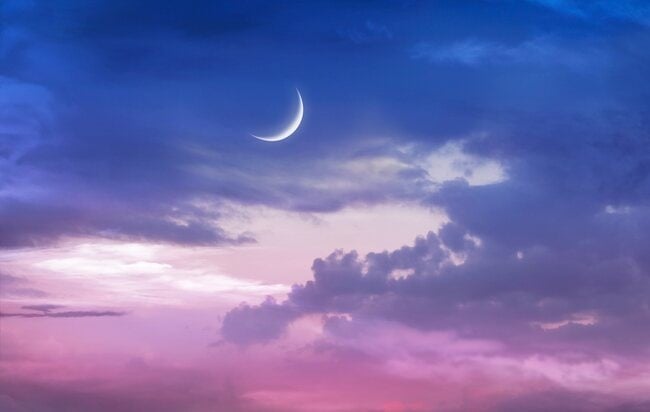
Quick Reference: The Next New Moon
- Next new Moon: Sunday, June 14, 2026 at 10:54 p.m. EDT (7:54 p.m. PDT, 02:54 UTC on June 15)
- Traditional name: New Strawberry Moon
- Following new Moon: Tuesday, July 14, 2026 at 5:44 a.m. EDT
- How often: Roughly every 29.5 days (one lunar month or “moonth”)
- Why you cannot see it: The lit side of the Moon faces the Sun, not Earth
- Why stargazers love it: The darkest night skies of the month fall on new-Moon nights
The next new Moon arrives on Sunday, June 14, 2026 at 10:54 p.m. EDT (7:54 p.m. PDT, 02:54 UTC on June 15). Not to be confused with a full Moon, a new Moon is usually impossible to see because it is drowned out by the Sun’s bright light during the day. (There are some exceptions, and we will get to those.) Learn about this unique lunar phase and why it is an ideal time for stargazing. Plan your next starry camping trip or break out your telescope using our 2026 and 2027 calendars below. And if you love crescent Moons, keep scrolling to the Crescent Moon Calendar.
When Is the Next New Moon?
From our vantage point in May 2026, the next new Moon is Sunday, June 14, 2026 at 10:54 p.m. EDT. In other time zones that is 9:54 p.m. CDT, 8:54 p.m. MDT, 7:54 p.m. PDT, and 02:54 UTC on Monday, June 15. The traditional Farmers’ Almanac name for this lunation is the New Strawberry Moon, ascribed two weeks before its bright counterpart, the Full Strawberry Moon on June 29.
The Moon will not be visible to the naked eye that night. At the new phase, the Moon sits roughly between the Earth and Sun, so the lit hemisphere faces away from us. Anyone hoping to catch a glimpse should look instead for the thin waxing crescent that appears low in the western sky one or two evenings after, around June 16 and 17. For exact rise and set times in your town, the U.S. Naval Observatory’s Sun and Moon Data tool is the authoritative reference.
New Moon Dates and Times for 2026
Although a big, bold, beautiful full Moon lighting up the night sky is a sight worth setting an alarm for, all of that lunar light also washes out the stars. If you want to see the most stars at night, stargaze around the time of a new Moon. The darkest skies of each month, the times you can see the fainter stars and constellations, are a few nights before and after the new Moon. After reviewing the calendars below, see our Best Days for Stargazing.
|
New Moon 2026 Calendar
|
||
|---|---|---|
| New Moon Date | Native American Name | Eastern Time |
| January 18 | New Snow Moon | 2:52 PM |
| February 17 | New Worm Moon | 7:01 AM |
| March 18 | New Pink Moon | 9:23 PM |
| April 17 | New Flower Moon | 7:52 AM |
| May 16 | New Blue Moon | 4:01 PM |
| June 14 | New Strawberry Moon | 10:54 PM |
| July 14 | New Buck Moon | 5:44 AM |
| August 12 | New Sturgeon Moon | 1:37 PM |
| September 10 | New Harvest Moon | 11:27 PM |
| October 10 | New Hunter’s Moon | 11:50 AM |
| November 9 | New Beaver Moon | 2:02 AM |
| December 8 | New Cold Moon | 7:52 PM |
Note: Times listed are Eastern Standard (or Eastern Daylight when appropriate).
New Moon Dates for 2027
Planning a stargazing weekend a year ahead? Here is the rolling preview for 2027, drawn from NASA’s lunar phase tables. Times are approximate in Eastern Time and will be refined as the year approaches.
| New Moon Date | Traditional Name | Eastern Time |
|---|---|---|
| January 7, 2027 | New Wolf Moon | 11:24 AM |
| February 6, 2027 | New Snow Moon | 10:56 AM |
| March 8, 2027 | New Worm Moon | 5:29 AM |
| April 6, 2027 | New Pink Moon | 7:51 PM |
| May 6, 2027 | New Flower Moon | 6:58 AM |
| June 4, 2027 | New Strawberry Moon | 6:40 PM |
| July 4, 2027 | New Buck Moon | 5:02 AM |
| August 2, 2027 | New Sturgeon Moon | 2:05 PM |
| September 1, 2027 | New Harvest Moon | 12:41 AM |
| September 30, 2027 | New Hunter’s Moon | 2:36 PM |
| October 30, 2027 | New Beaver Moon | 5:36 AM |
| November 28, 2027 | New Cold Moon | 11:24 PM |
| December 28, 2027 | New Wolf Moon | 4:11 PM |
Note that 2027 contains thirteen new Moons, which means two land in the same calendar month. The second new Moon of a season with four new Moons is called a Black Moon in modern usage, though the Almanac has its own older term for it (see “The Buzz About Black Moon” below).
What Is a New Moon?
A new Moon occurs when the Moon comes between the Earth and Sun, which usually happens once a month. If these celestial bodies are perfectly aligned, a solar eclipse takes place. See when the next eclipse will occur.
A new Moon marks the end of one lunar cycle and the beginning of the next. For instance, when the Full Harvest Moon wanes and finally becomes a new Moon (about two weeks later), the Hunter’s Moon cycle begins and waxes until the next full Moon occurs (about another two weeks later). Any questions? Ask us in the comments.
The technical definition is precise: the new Moon is the instant when the Moon and Sun share the same ecliptic longitude, also called conjunction. That instant is what astronomers use to set the timestamps in our calendar tables. According to NASA, conjunction happens roughly every 29 days, 12 hours, 44 minutes, and 3 seconds, the length of one synodic month.
The Lunar Cycle Explained: The Eight Phases
One lunar cycle, the round trip from new Moon to new Moon, takes about 29.5 days and passes through eight named phases. The new Moon is phase one. Each phase has its own feel for stargazers, gardeners, and anyone keeping an eye on the night sky.
- New Moon (day 0): Moon sits between Earth and Sun. Invisible. Darkest skies of the month.
- Waxing Crescent (days 1 to 7): A sliver appears low in the western sky after sunset.
- First Quarter (day 7): Half the face is lit. Visible in the afternoon and evening.
- Waxing Gibbous (days 8 to 13): More than half lit, growing toward full.
- Full Moon (day 14): The whole face is lit. Visible all night.
- Waning Gibbous (days 15 to 21): Slowly shrinking back from full.
- Last Quarter (day 22): Half-lit again, this time on the opposite side. Visible from midnight to morning.
- Waning Crescent (days 23 to 29): Thin sliver in the eastern sky before sunrise, dropping toward the next new Moon.

When Is a New Moon Visible?
A new Moon may become visible, very, very rarely, in the event of a solar eclipse. During these times, it comes precisely between Earth and the Sun. When the Moon blocks a portion of the Sun (looking like a monster took a bite of the solar disc), this is called a partial solar eclipse.

When the Moon slides in front of and obscures the entire Sun, that is a total solar eclipse. These events only occur during a “new” phase. As a general rule, three days before and after a new Moon, a thin crescent Moon becomes visible to the unaided eye.
How to View the Sky at a New Moon
For stargazers, the new Moon is a gift. With no moonlight washing out the sky, the faintest stars, the dustier reaches of the Milky Way, and the deepest deep-sky objects all come within reach of a modest telescope or even a good pair of binoculars. Here is a short list of what to chase on a new-Moon night:
- The Milky Way’s core. From late spring through early autumn, the bright bulge of our galaxy rises in the southeast after dark. A new-Moon night, away from city lights, is when the dust lanes show.
- Meteor showers. When a major shower (the Perseids in August, the Geminids in December, the Leonids in November) peaks near a new Moon, you may count two or three times more meteors than in a bright-Moon year. Check the new-Moon dates above against the stargazing guide when you plan a meteor-watch night.
- Faint constellations. Cancer the Crab, Camelopardalis the Giraffe, and the dim reaches of Eridanus all but vanish under a full Moon. A new-Moon night brings them back.
- Galaxies and nebulae. The Andromeda Galaxy, the Orion Nebula, and the Beehive Cluster look their best when there is no Moon in the sky.
Drive at least thirty minutes from the nearest big-town glow if you can. Let your eyes dark-adapt for twenty minutes (no phone screens). A red flashlight will preserve night vision while you check a star chart. Dress one layer warmer than you think you need; even a June evening can chill quickly once you stop walking.
The Buzz About “Black Moon”
You may have heard people on social media calling a particular new Moon a “Black Moon,” but this is not an Almanac term. A Black Moon by the Almanac’s definition is an alternative name for February’s Moon when there are not enough days in the month to ripen and become a Full Snow Moon.
Actually, the Almanac’s ancient “Book of Answers” refers to the second new Moon of a month or the third new Moon of a season (when there are four within any season) as a Green Moon. However, if you are interested in learning more about the so-called “Black” Moon, we invite you to check out this article from our friends at EarthSky.org.
New Moon 2025 Dates and Times (Last Year’s Reference)
For readers checking back on past sightings or matching a journal entry to a Moon phase, here is the 2025 calendar in full. The last new Moon of 2025 was the New Wolf Moon on December 19 at 8:43 p.m. EST (5:43 p.m. PST).
|
New Moon 2025 Calendar
|
||
|---|---|---|
| New Moon Date | Native American Name | Eastern Time |
| January 29 | New Snow Moon | 7:35 AM |
| February 27 | New Worm Moon | 7:44 PM |
| March 29 | New Pink Moon | 6:57 AM |
| April 27 | New Flower Moon | 3:31 PM |
| May 26 | New Strawberry Moon | 11:02 PM |
| June 25 | New Buck Moon | 6:31 AM |
| July 24 | New Sturgeon Moon | 3:11 PM |
| August 23 | New Corn Moon | 2:06 AM |
| September 21 | New Harvest Moon | 3:54 PM |
| October 21 | New Beaver Moon | 8:25 AM |
| November 20 | New Cold Moon | 1:47 AM |
| December 19 | New Wolf Moon | 8:43 PM |
Lunar Names
It is a Farmers’ Almanac tradition to call out the historical names for each Moon over the course of the year. For instance, June’s Strawberry Moon. Typically these names are associated with the “full” phase, when the Moon is brightest and most apparent in the sky, but these names are actually ascribed approximately two weeks prior, upon each new Moon. We included these names in the calendars above so you may anticipate them as they grow into beautiful brightness.
Any questions? Contact questions@farmersalmanac.com
A Lunar Month Or “Moonth”
Ancient civilizations around the world often used the lunar phases as a calendar. They would mark the passing of time by lunar months or “moonths.” Similar to the length of a month (approximately four weeks), a lunar month is the period of time it takes for the lunar cycle to repeat, roughly 29.5 days.
The most common start to a lunar month is the “new” phase. However this name once had a different meaning. In the ancient sense, it referred to the first moment that the Moon could be observed (after being completely invisible in the sky) as it emerged in a waning crescent stage, appearing to be reborn in light.
Stargazers would witness the slimmest crescent hanging in the twilight of the western sky and call it “new,” but this sight actually occurs approximately 12 to 24 hours after the point that astronomers would consider to be “new” today.
Once a crescent was sighted, the new month would begin. The timing of annual religious holidays including Lunar New Year, Ramadan, Easter, and Rosh Hashanah are linked to accurately identifying lunar phases. After centuries of such observations, ancient cultures could then calculate the timing without having to see it. If their predictions were accurate enough, they could even forecast the most dramatic of astronomical events: a total solar eclipse. (Solar eclipses only happen during a “new” phase.)
The New Moon, the Zodiac, and Intention-Setting
Long before electric calendars and weather apps, the new Moon was the moment readers used to set the rhythm for the month ahead. Each new Moon falls in one of the twelve zodiac signs, and many of our readers use that sign as a planning prompt: a new Moon in Taurus for the home and garden, a new Moon in Cancer for family, a new Moon in Capricorn for work and finances. The Farmers’ Almanac treats the zodiac as a planning tool, not a fortune-telling system. There is no claim here that the Moon decides your week. What the Moon does is mark time clearly, and a clear marker is a useful place to start a new project.
If you keep a journal, a notebook, or a kitchen list, try this: on the day of the new Moon, write down three things you would like to begin or finish in the coming twenty-nine days. Two weeks later, at the full Moon, check in. Two weeks after that, at the next new Moon, close the loop. It is a simple, low-stakes way to ride the lunar rhythm without leaning on superstition.
The New Moon and Gardening by the Moon
Generations of Almanac readers have planted by the Moon. The simple rule, drawn from the Almanac’s Best Days Calendar and laid out in the Gardening by the Moon Calendar, is this: the days from new Moon to first quarter favor leafy, above-ground crops; the days from first quarter to full Moon favor fruiting, above-ground crops; the days from full Moon to last quarter favor root crops and below-ground work; the days from last quarter to new Moon are best for weeding, pruning, and resting the soil.
The science behind the rule is more about soil moisture and reader discipline than mysticism. Around the new Moon, gravitational pull from the Sun and Moon combine to lift groundwater slightly higher, which can favor germination of seeded crops. More importantly, planting by the calendar gives the home gardener a fixed schedule that does not drift. A bed that is sown on the new-Moon day in June is a bed that gets sown, full stop. The rest is good seed, decent soil, and a watering can.
Pair the new-Moon dates above with the Almanac’s Daily Planner for the freshest signals on planting, fishing, and the rest of the slow chores that make up a country season.
Crescent Moon Calendar 2025
Do you love looking up at the sky and seeing a beautiful crescent Moon? Here are some of the best days, times, and directions to look. (Note: these dates are from the 2025 calendar and are kept here as a historical reference; an updated 2026 crescent table will follow the lunar phase data above.)
|
Crescent Moon Calendar 2025
|
||
|---|---|---|
| Dates | Time | Direction |
| January 2, 3, 4 | 1-2 hours after sunset | West |
| January 24, 25, 26 | 1-2 hours before sunrise | East |
| February 1, 2, 3 | 1-2 hours after sunset | West |
| February 22, 23, 24 | 1-2 hours before sunrise | East |
| March 2, 3, 4 | 1-2 hours after sunset | West |
| March 24, 25, 26 | 1-2 hours before sunrise | East |
| April 1, 2, 3 | 1-2 hours after sunset | West |
| April 22, 23, 24 | 1-2 hours before sunrise | East |
| April 30, May 1, 2 | 1-2 hours after sunset | West |
| May 21, 22, 23 | 1-2 hours before sunrise | East |
| May 29, 30, 31 | 1-2 hours after sunset | West |
| June 20, 21, 22 | 1-2 hours before sunrise | East |
| June 28, 29, 30 | 1-2 hours after sunset | West |
| July 19, 20, 21 | 1-2 hours before sunrise | East |
| July 27, 28, 29 | 1-2 hours after sunset | West |
| August 18, 19, 20 | 1-2 hours before sunrise | East |
| August 26, 27, 28 | 1-2 hours after sunset | West |
| September 16, 17, 18 | 1-2 hours before sunrise | East |
| September 24, 25, 26 | 1-2 hours after sunset | West |
| October 16, 17, 18 | 1-2 hours before sunrise | East |
| October 24, 25, 26 | 1-2 hours after sunset | West |
| November 15, 16, 17 | 1-2 hours before sunrise | East |
| November 23, 24, 25 | 1-2 hours after sunset | West |
| December 14, 15, 16 | 1-2 hours before sunrise | East |
| December 22, 23, 24 | 1-2 hours after sunset | West |
A Note from the Editor
The new Moon is the quietest night in the lunar cycle. The sky is dark, the air feels still, and the next month is sitting there waiting for you to fill it. Pick one thing for it. Sow a row of lettuce. Take the kids out to count meteors. Start the next chapter. Then, in two weeks, look up at the full Moon and see how far you have come.

Frequently Asked Questions
When is the next new Moon?
The next new Moon is Sunday, June 14, 2026 at 10:54 p.m. EDT (7:54 p.m. PDT, 02:54 UTC on June 15). The Farmers’ Almanac calls it the New Strawberry Moon. The new Moon after that is Tuesday, July 14, 2026 at 5:44 a.m. EDT.
Can you see a new Moon?
No, not under normal conditions. At the new phase the lit half of the Moon faces the Sun, so from Earth we see the unlit side. The only exception is a solar eclipse, when the Moon passes directly in front of the Sun and the disc becomes visible as a silhouette. A thin waxing crescent becomes visible one or two evenings after the new Moon, low in the western sky after sunset.
How often does a new Moon happen?
About once every 29.5 days. That is the length of one synodic month, the time it takes the Moon to complete a full cycle of phases as seen from Earth. Most calendar years contain twelve new Moons; about every 33 months a thirteenth one slips in, which is what produces the so-called Black Moon.
Is a new Moon a good time to stargaze?
Yes. With no Moon in the sky, fainter stars, the Milky Way’s dust lanes, and deep-sky objects like the Andromeda Galaxy all become easier to see. If a meteor shower peaks within a few days of a new Moon, expect a noticeably stronger show. Plan a few nights either side of the dates in our 2026 calendar above for the darkest skies of each month.
What is the difference between a new Moon and a full Moon?
A new Moon and a full Moon are opposite phases of the same cycle. At the new Moon the Sun, Moon, and Earth line up in that order, so the Moon is invisible from Earth. At the full Moon the order is Sun, Earth, Moon, so the lit side of the Moon faces us and the disc looks fully bright. The two phases are about 14.75 days apart.
What should I plant on a new Moon?
By the Almanac’s Gardening by the Moon rule, the days from new Moon to first quarter favor leafy, above-ground crops: lettuce, spinach, kale, chard, cabbage, and herbs. The days from first quarter to full Moon favor fruiting above-ground crops: beans, peppers, tomatoes, squash. See our Gardening Calendar for the full breakdown by date.
What is a Black Moon?
In modern usage on social media, a Black Moon is either the second new Moon in a single calendar month, or the third new Moon in a season that contains four. The Farmers’ Almanac does not use the term that way. By the Almanac’s older “Book of Answers,” that second new Moon is called a Green Moon, and Black Moon is the alternative name for February’s Moon in years when the month is too short to ripen into a full Snow Moon.
When is the first new Moon of 2027?
The first new Moon of 2027 is Thursday, January 7 at 11:24 a.m. EST. Traditionally called the New Wolf Moon, it falls during one of the darkest, coldest stretches of the year, which makes for excellent winter stargazing if you can stand the cold.


Dean Regas
Dean Regas is an astronomer and author of seven books including 100 Things to See in the Night Sky and How to Teach Grown-Ups About Pluto and host of the popular astronomy podcast Looking Up with Dean Regas. He can be reached at: www.astrodean.com
- Dean Regas

- Dean Regas
- Dean Regas
- Dean Regas

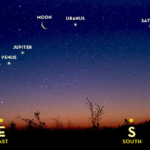

You say that the new moon is impossible to see because the sky is flooded with the light of the sun. My understanding of a new moon is that it is at night when the moon has risen and is not “visible, ” or is dark, because the sun. As a kid I marveled at this phenomenon.
He right, its not that the moon has not risen yet. It’s just the visible side of the moon is just facing away from earth as it do not rotate like the earth so one side is always facing the earth.